
Eastern and Oriental Orthodox Should Accept the Immaculate Conception
Or why the Immaculate Conception is a legitimate doctrinal development

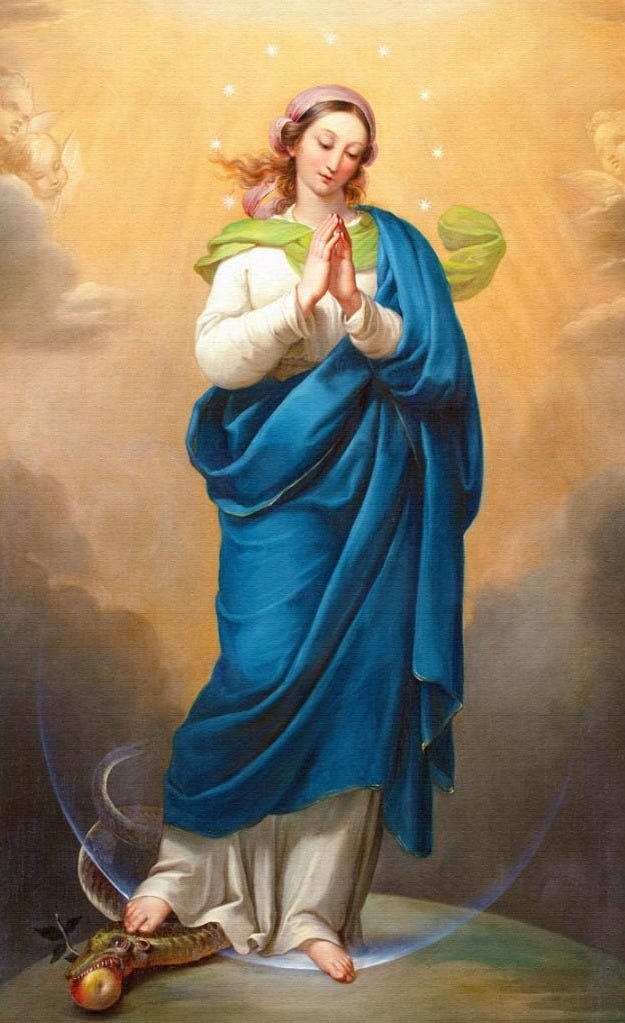
The dogma of Mary’s Immaculate Conception should be affirmed by all Christians, especially those who belong to the apostolic Churches that accept the Council of Ephesus (e.g. Eastern Orthodox and Oriental Orthodox). Here’s why.
Mary’s Sinlessness Affirmed by the Apostolic Churches
It goes without saying that we all affirm the total personal sinlessness of the Blessed Virgin Mary. That is, the doctrine that our Lady never committed any sins (mortal or venial) during her entire life. This belief can be implicitly seen in the earliest known hymn to the Virgin Mary, the Sub tuum praesidium, which is still recited by all of our Churches today. It describes her as the “only pure one” and the “only blessed one,” language that doesn’t make much sense if the Virgin was a sinner like the rest of us. Indeed, the apostolic Churches would all converge on making this implicit doctrine explicit in their liturgical devotion to our Lady.
Just attend any Byzantine liturgy and you will hear how the language of the Sub tuum praesidium develops into our Lady being called All-Holy, Most Pure, All-Blameless, Spotless, Immaculate, Undefiled, and so forth—titles that aren’t used of any other saint. Likewise, read through Nectarios of Aegina’s beautiful hymn, O Pure Virgin, or the lovely Akathist Hymn to the Theotokos, and you will see how prominently the Byzantine tradition exalts Mary as sinless. The doctrinal Council of Jerusalem 1672, when naming those who “did not experience” actual sins, confirms among them, “especially the Mother of God the Word, the ever-virgin Mary.”1
The Oriental Orthodox tradition is just as clear. Like the Byzantine liturgy, the Coptic liturgy calls on our Lady under these beautiful titles, “Most of all, the pure, full of glory, ever-virgin, holy Theotokos.”2 Severus of Antioch (d. 538) helps explain what the Oriental Orthodox mean by this language, “She formed part of the human race and was of the same essence as we, although she was pure from all taint and immaculate.”3 Jacob of Serugh (d. 521) goes so far as to say, “[Mary] alone is humble, pure, limpid and without blemish, so that she was deemed worthy to be his mother and not another… If there had been a spot in her soul or a defect, He would have sought for Himself another mother in whom there is no blemish.”4
To all of this, the Catholic Church responds, “Yes and amen.”
Mary’s Sinlessness Questioned by Early Fathers
However, there’s a difficulty that arises for all of our traditions when it comes to defending this belief on historical grounds. As Kevin Fernandez highlights, many of the early fathers and theologians (shared by all three Churches) expressly denied the total sinlessness of the Blessed Virgin Mary.
St. John Chrysostom (d. 407), for example, reads Christ’s response to our Lady at the wedding of Cana in this way: “He rebuked her, saying, ‘What is this between me and you, woman?’ (John 2:4) – to instruct her, so that she would not do the same in the future.”5 Elsewhere Chrysostom understands the Virgin’s actions in Matthew 12:46 as her acting “from excessive vanity,” and engaging in the same “madness” as the brothers of Jesus, “not yet thinking of [Christ] in a truly great way.”6 If this isn’t imputing sin to the Virgin Mary, then I’m not sure what would be.
Most interesting are the arguments for Mary’s sinfulness given by both Origen of Alexandria (d. 253) and St. Basil the Great (d. 379). Let’s start with Origen:
Why do we think that the mother of the Lord was immune from scandal when the apostles were scandalized? If she did not suffer scandal at the Lord’s Passion, then Jesus did not die for her sins. But, if ‘all have sinned and lack God’s glory, but are justified by his grace and redeemed,’ then Mary too was scandalized at that time.
Origen, Homily XVII on Luke, n. 6 (PG 13, 1845), qtd. in Kevin Fernandez, “The Virgin Mary’s Sinlessness in the Early Church.”
Representing the third century Alexandrian tradition, Origen reveals the likely reason why early Christians were intent on reading some sinfulness into our Lady: if she never committed any actual sins during her life, “then Jesus did not die for her sins.”
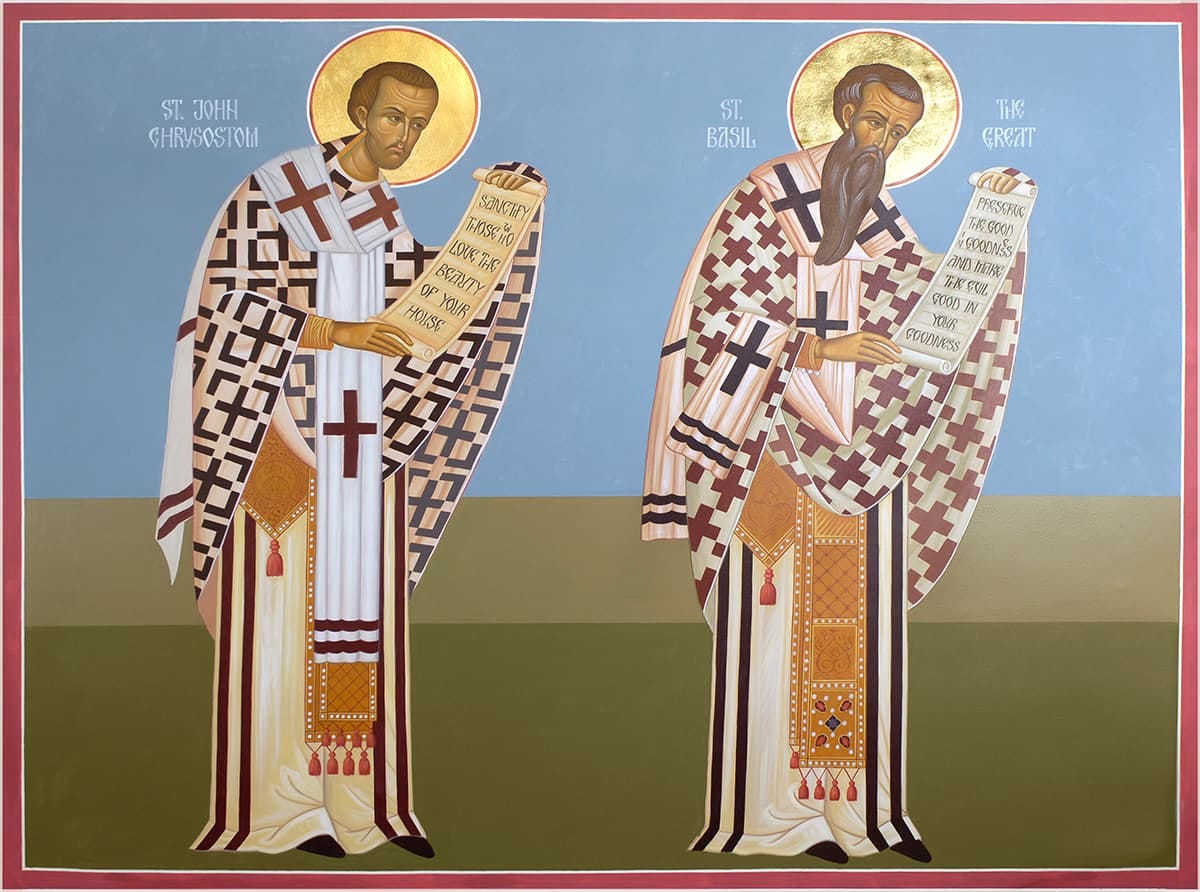
St. Basil the Great, interpreting the same biblical text (Lk 2:35) as Origen about one century later, comes to the same conclusion:
Now every soul in the hour of the Passion was subjected, as it were, to a kind of searching. According to the word of the Lord it is said, ‘All you shall be offended because of me.’ Simeon therefore prophesies about Mary herself, that when standing by the cross, and beholding what is being done, and hearing the voices, after the witness of Gabriel, after her secret knowledge of the divine conception, after the great exhibition of miracles, she shall feel about her soul a mighty tempest. The Lord was bound to taste of death for every man — to become a propitiation for the world and to justify all men by His own blood. Even you yourself, who hast been taught from on high the things concerning the Lord, shall be reached by some doubt. This is the sword. That the thoughts of many hearts may be revealed. He indicates that after the offense at the Cross of Christ a certain swift healing shall come from the Lord to the disciples and to Mary herself, confirming their heart in faith in Him. In the same way we saw Peter, after he had been offended, holding more firmly to his faith in Christ. What was human in him was proved unsound, that the power of the Lord might be shown.
St. Basil, Letter 260, 9.
According to Basil, because Christ “was bound to taste of death for every man,” it was necessary that “every soul in the hour of the Passion was subjected” to doubt, Mary included. This is why, after the Passion, “healing” needed to come not only “to the disciples,” but also “to Mary herself,” since they had all fallen away from faith “in the same way.” Once again, like Origen, Basil believes that this was necessary in order for Christ “to justify all men,” Mary included, “by His own blood.”
As I’ll explain below, even St. Cyril of Alexandria himself affirmed the position of Origen and St. Basil that our Lady had sinful doubts at the Cross.
So how did the apostolic Churches come to affirm the total sinlessness of the Virgin in the face of these dissenting patristic voices?
The Development of Mary’s Sinlessness and Original Sin
Consider that the Marian piety contemporary with Origen, St. Basil, and St. John Chrysostom did allude to her sinlessness. We already saw this in the Sub tuum praesidium prayer, which declares the Virgin alone to be “pure” and “blessed.” Fathers like St. Ephrem the Syrian (d. 373) likewise prayed, “You [Christ] alone and Your mother, more than all, are very fair. There is no blemish on You, O my Lord, and no spots on Your mother.”7 St. Epiphanius of Salmis (d. 403) similarly affirms that our Lady committed (at least) no mortal sins: “How can the holy Mary not inherit the kingdom of heaven, flesh and all, when she did not commit fornication or uncleanness or adultery or do any of the intolerable deeds of the flesh, but remained undefiled?”8
Why is this?
I believe the answer lies in the early (perhaps even apostolic)9 identification of Mary as the new Eve. In a theological paradigm where Jesus the new Adam and Mary the new Eve are righteous, in distinction to the old Adam and Eve who are sinful, it’s understandable to want to attribute as little sin to our Lady as possible. Hence even among the fathers who deny Mary’s sinlessness, they hold her to have sinned only once or twice in her entire lifetime (in enormous contrast to many Protestants who believe that our Lady was a sinner “just like the rest of us”).
Once this is understood, it sheds light on why some of these fathers felt compelled to impute sinfulness to our Lady at all. It’s not as if these fathers were impious and particularly wanted to attribute sin to the Blessed Virgin. Instead, the reality is that they hadn’t theologically worked out how Mary could have committed no sins and yet still be in need of a Redeemer. As a result, since the Christian impulse was always to attribute as little sin to Mary as possible, while safeguarding her need for a Savior, the best many fathers could do was to minimize the number of sins she committed.
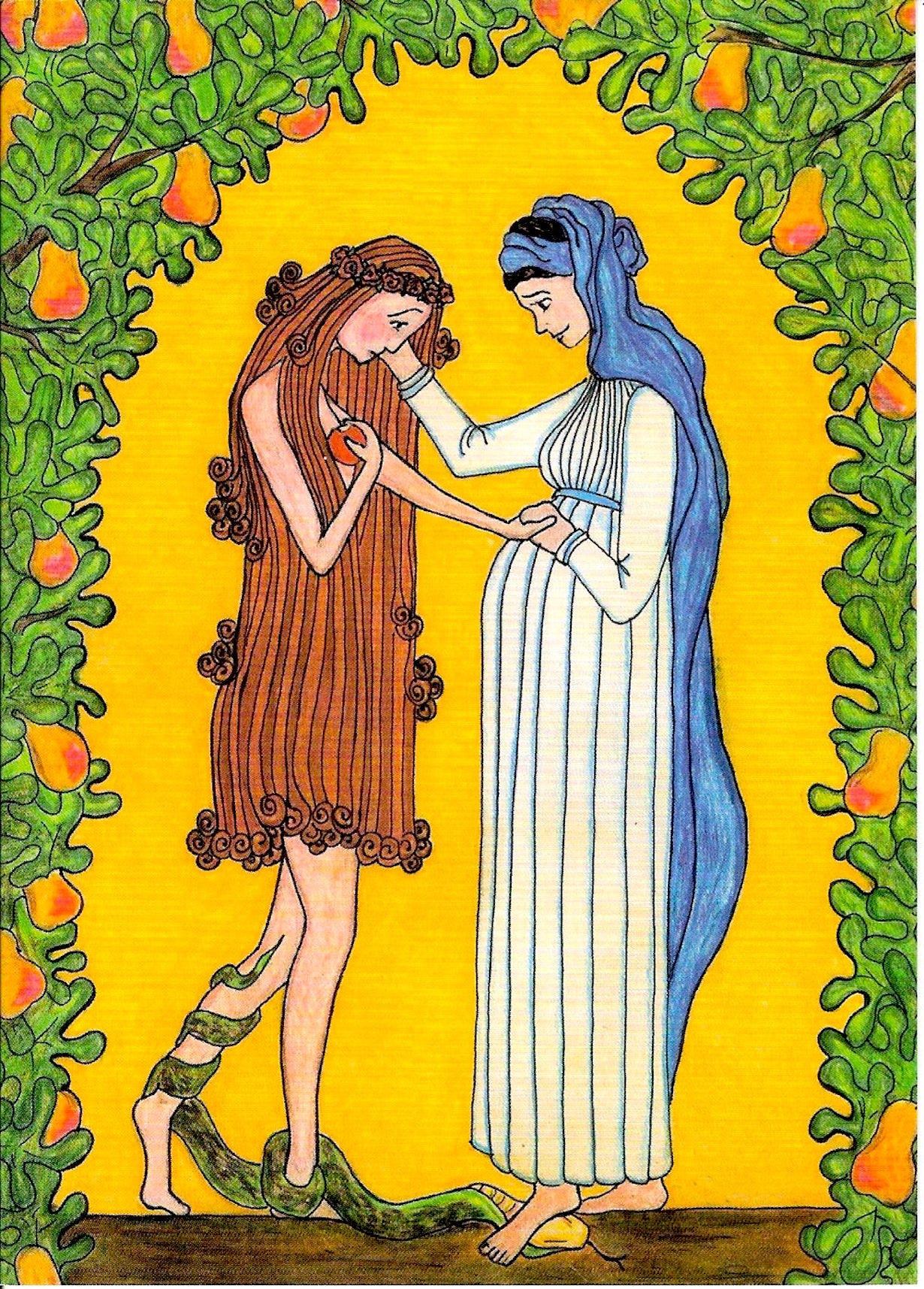
It therefore comes as no surprise that, by the time we see the total sinlessness of the Virgin cement itself in the patristic mind (ca. fifth century), this doctrine is developing alongside another one that directly addresses the issue of how one can be personally sinless and yet still need a Savior: original sin.
The doctrine of original sin is quite controversial in the modern day, especially among our separated eastern brethren. However, in the fifth century, the only major sect that opposed this doctrine was the heretical Pelagians. So much could be said about the Pelagian controversy, St. Augustine’s teachings on original sin, and the Church’s reception of those teachings.10 But what I want to focus on is this: one of the things that came out of the Pelagian controversy was the Church’s emphatic affirmation that, via original sin, it’s indeed possible for someone to have committed no personal sins, and yet still be in need of Christ’s salvation.
The classic example of this is infants. St. Augustine famously questioned Julian the Pelagian on how he could affirm that Christ died for infants if they had no sin: “[Julian] asks: ‘How are infants guilty, for whom Christ died?’ We answer: Nay, how are infants not guilty, since Christ died for them?”11 The brilliant point Augustine makes against Julian is that, if Christ died for infants, and if His blood was “shed for many for the remission of sins” (Matt 26:28), then it follows that infants, despite not having committed any actual sins, must still have some sin for which Christ died. This sin is what we call “original sin.”
Augustine thus opens a new category of human beings who, despite being perfectly sinless (in terms of actual sin), nonetheless still need to be saved by the redeeming sacrifice of Jesus Christ.
The impact this would have on the Church’s Mariology should be obvious. Since, once again, Christians have always believed that our Lady, without compromising her need for a Savior, had as little sin as possible, it makes sense that Augustine’s theological insights would allow the Church’s theologians to boldly proclaim that Mary never committed any actual sins.
The Council of Ephesus, Pelagianism, and the Development of Mary’s Sinlessness
I believe the Council of Ephesus 431 is a perfect illustration of how and when this doctrinal development took place.
It’s an undisputed fact (as far as I can tell) that Ephesus’ dogmatization of our Lady as the “Theotokos,” the God-bearer, led to a dramatic increase in Marian devotion in the decades and centuries following A.D. 431. I contend that Ephesus was also the event that led to the Church’s firm adoption of the doctrine of Mary’s sinlessness.
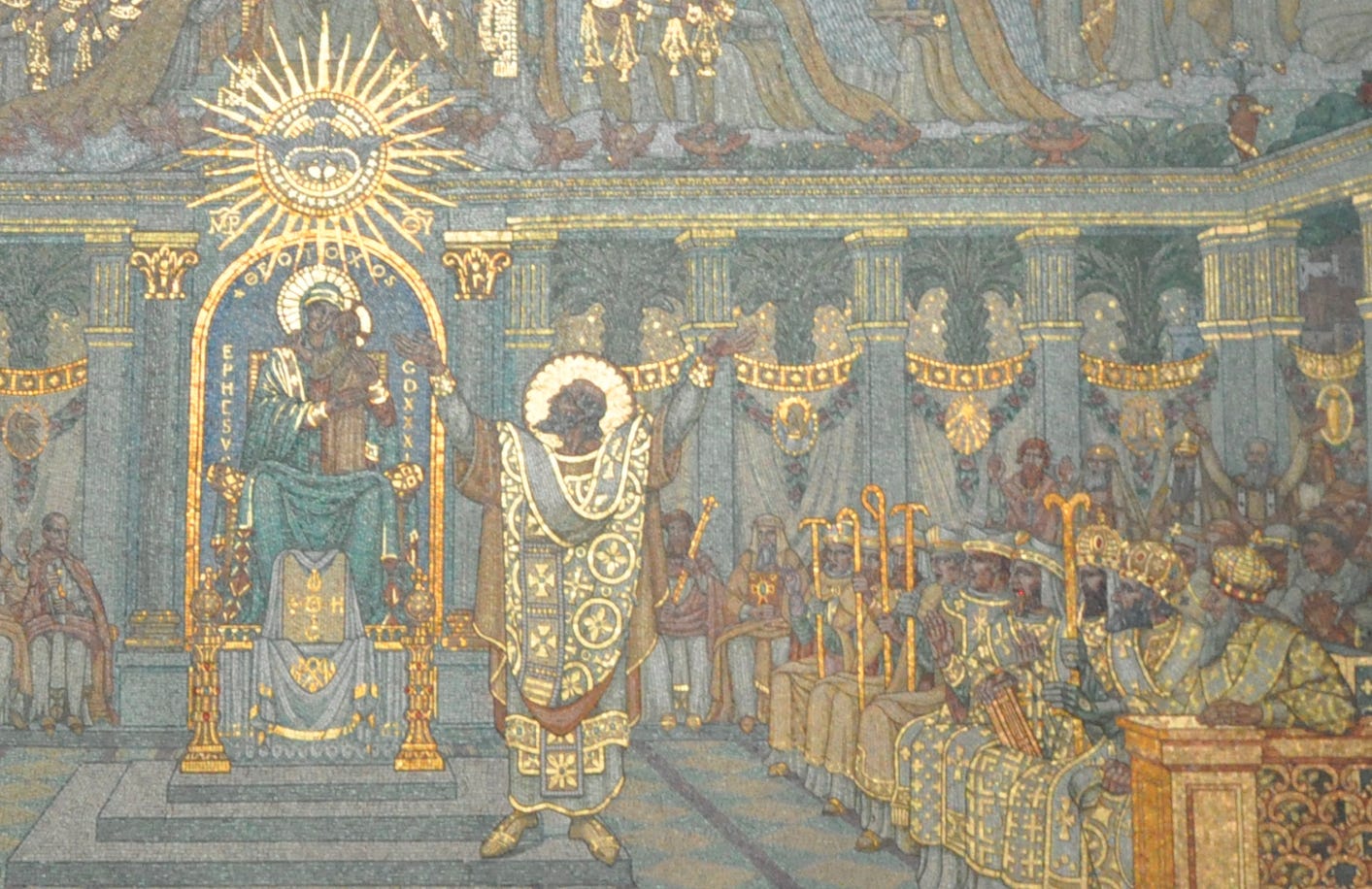
This was already starting with the theological champion of that very council, St. Cyril of Alexandria (d. 444). He not only vigorously defended our Lady as the All-Holy Mother of God against Nestorius, but he was also one of the first of the Church’s theologians to affirm that it is “through [Mary]” that “every faithful soul achieves salvation.”12 His homilies have beautiful words in praise of the Blessed Virgin that go just a bit beyond what we would (ordinarily) have seen a century or so earlier.13 As Fr. Gambero affirms, “One can safely state that Cyril of Alexandria inaugurated the much-beloved Byzantine homiletic technique in which the preacher would teach Marian truths by means of praises addressed to the Blessed Virgin.”14
Though St. Cyril himself denied our Lady’s sinlessness,15 his Marian devotion was developed and deepened by his disciples in both the Oriental Orthodox tradition (as we saw above with Severus of Antioch and Jacob of Serugh), and the Byzantine tradition. Indeed, less than a century will go by before we get the aforementioned Akathist Hymn to the Theotokos, which contains many lines that won’t sound foreign to readers of Cyril and the post-fifth century Alexandrian tradition. Unsurprisingly, all of these sources affirm our Lady’s total sinlessness.
I thus find it quite telling that Nestorianism wasn’t the only heresy condemned by this “Marian” Council of Ephesus. Rather, Ephesus likewise condemned (surprise surprise) the heresy of Celestius the Pelagian. Geoffrey Dunn documents this as follows:
At the Council of Ephesus in 431, which we may well describe as Cyril’s own ecumenical council, in addition to the anathemas pronounced against Nestorianism, we find a canon threatening with deposition any metropolitan bishop who endorsed the teaching of Caelestius, a canon threatening with deposition any cleric who endorsed the teaching of either Nestorius or Caelestius, and a synodal letter to Celestine, bishop of Rome, noting that this had been done.
Geoffrey Dunn, “Augustine, Cyril of Alexandria, and the Pelagian Controversy,” p. 65.
Significantly, Dunn goes on to explain that, while there were many different theological views held by those we now identify as Pelagians, “the denial of the doctrine of original sin was the only ‘essential article of belief for any would-be Pelagian. Once there is agreement on that point there is a reasonable margin for different tendencies and emphases.’”16 Thus, if the condemnation of Celestius by Ephesus 431 meant anything, it meant the Church’s ecumenical acceptance of St. Augustine’s doctrine of original sin against the Pelagians’ denial thereof.
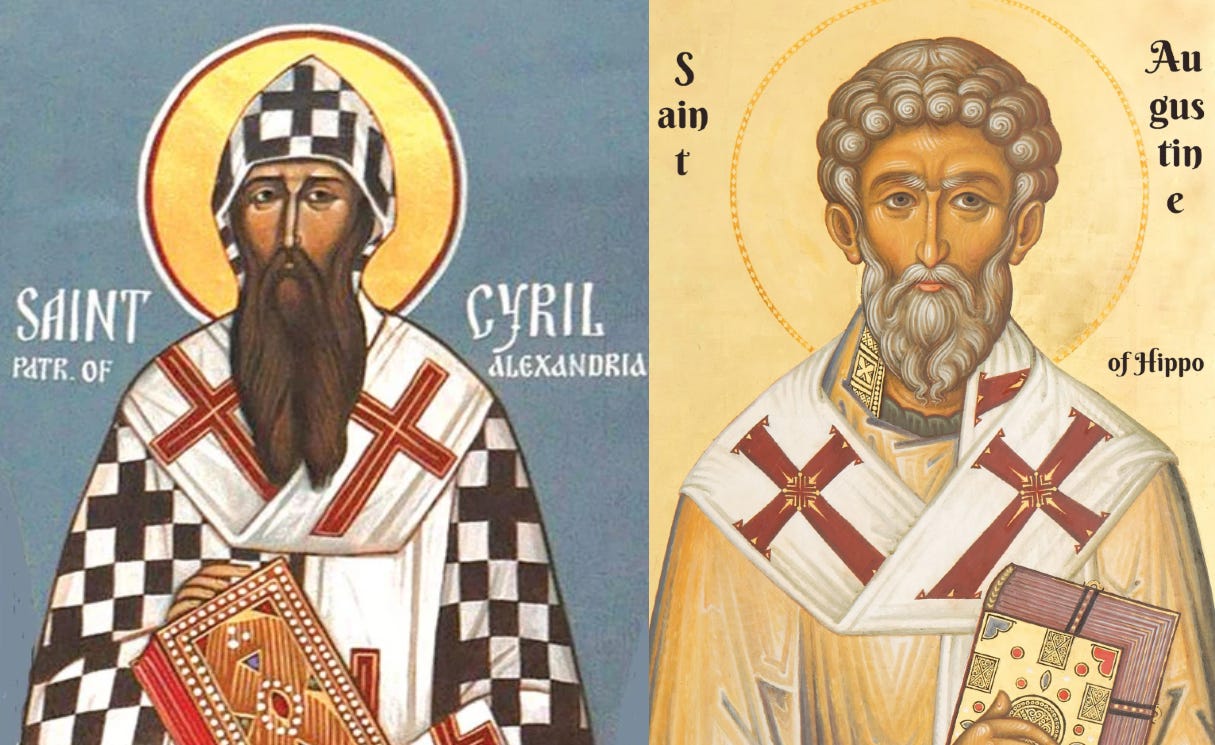
Further confirming this is a discovery that the Austrian scholar Johannes Divjak made in 1969. He found what has come to be known as the “Divjak letters,” one of which is a letter written by St. Augustine of Hippo to St. Cyril of Alexandria. Through this letter, we know that Cyril had access to (at least) a Greek version of Augustine’s De Gestis Pelagii, wherein he summarizes many of the errors of the Pelagians, among them being their effective denial of original sin. In other words, Cyril was almost certainly aware of what Augustine thought about original sin, and he therefore endorsed it by condemning one of Augustine’s chief theological opponents at Ephesus.
Moreover, as Nathaniel McCallum demonstrates at length, when it comes to the content of Augustine’s doctrine of original sin, we find “significantly overlapping ideas in [the writings of] Cyril, demonstrating (contra Romanides and Meyendorff) that at least one prominent Greek Father had integrated a sense of guilt from solidarity with Adam as Augustine has done.”17
Circling back to the main thesis of the present article, here’s what’s certain. St. Cyril and the Council of Ephesus simultaneously (1) drew theological attention to our Lady as the All-Pure, All-Holy Mother of God (contra Nestorius), and (2) doctrinally cemented a category for someone who never committed any actual sins, and yet still needed to be redeemed by Christ (contra Pelagius and Celestius). Given the Church’s belief has always been that, to whatever extent it’s theologically possible for Mary to have been sinless, to that extent she was, in fact, sinless, it’s perfectly understandable why this leads to the explicit and emphatic proclamation of our Lady’s total sinlessness in the post-Ephesian Church.
We thus see doctrinal development at work. While earlier fathers didn’t hold to the sinlessness of the Virgin, they did affirm the theological principle that would enable later fathers to hold this position. This process of development, I will argue, is exactly what happened with the doctrine of our Lady’s Immaculate Conception as well, and it’s the reason why all apostolic Christians should be consistent and hold to it.
The Debitum Peccati and the Immaculate Conception
At this point, there may be many Eastern and Oriental Orthodox who agree with the arguments I’ve made. Perhaps they would try to downplay the extent to which doctrinal development occurred with respect to Mary’s sinlessness (though they would be unsuccessful), but they could still affirm most of what I’ve said and deny the Immaculate Conception. This is the matter to which we now turn.
Fernandez wrote another brilliant article which I recommend all of my readers take a look at, “Did St. Augustine Believe in the Immaculate Conception of Mary?.” If my analysis thus far is correct, then this title asks a very relevant question. Augustine was at the forefront of hammering out the Church’s doctrine of original sin, and he was also living during the time period in which Mary’s sinlessness was coming to be accepted by the whole Church. It’s therefore very instructive to know that Augustine, arguably, affirmed our Lady’s exemption from original sin. Fernandez certainly makes a compelling case for this in his article.
But how could Augustine do this given his emphasis on the sinfulness of even the most innocent among us? This is where we need to make an important distinction between two different senses of original sin. This is where a lot of non-Catholic critics of the Immaculate Conception get confused, so pay close attention.
First, we have original sin in the sense of the state of being deprived of original justice or sanctifying grace. This is a spiritual condition that affects the soul alone, and it’s the condition into which all of us were born. Indeed, it’s the condition that justifies the Church’s practice of infant baptism—if infants weren’t originally deprived of sanctifying grace, then they wouldn’t need to receive it in baptism.
It’s this sense of original sin, and this sense alone,18 that Catholics refuse to predicate of the Blessed Virgin Mary. In other words, when we say that “by a singular grace” our Lady “was preserved free from all stain of original sin,” we mean that her soul was in a state of grace from the first moment of its creation. There was never a point in time when, if Mary had died, she would have gone to hell. Not even for a fraction of a millisecond was our Lady under the domain of Satan, rather her soul was always under the dominion of grace. This is what’s meant when we say that the Virgin was immaculately conceived or conceived without sin.
This is to be distinguished from the second sense of original sin, what many theologians call the debitum peccati. This is the fallen condition of the flesh that receives a soul, a soul which it then stains with the aforementioned sense of original sin. The analogy St. Augustine uses to describe this is, just as a dirty vessel taints its content, so does “dirty flesh,” flesh conceived naturally in concupiscence, taint the soul with the stain of original sin, i.e. the deprivation of sanctifying grace.19
This debitum peccati, what we can even call “the debt of original sin,” is something that Catholics believe Mary had in her flesh. Unlike our Lord, our Lady was conceived naturally and therefore had fallen flesh from Adam that was subject to receiving original sin (her body had a “debt” to taint her soul with original sin). The “singular grace” of the Immaculate Conception is precisely the grace that stopped this from happening.
Consider the difference, from a Catholic perspective, between the sinless conceptions of Jesus and Mary. Did Jesus need a Savior? Absolutely not. But why? Because His flesh was conceived supernaturally, i.e. not out of concupiscence, and therefore His soul was never subject to receiving original sin in the first place. Christ didn’t need a Savior because there was nothing from which He needed to be saved.
This is different from Mary, who absolutely did need a Savior, and who therefore did need something from which she could be saved. What was she saved from? Her soul was saved from contracting original sin. But why was her soul going to contract original sin if God didn’t redemptively intervene to stop it? Because her flesh had the debt of original sin as a result of being conceived naturally. It’s therefore because our Lord freed our Lady from the effect of this debt (i.e. the contraction of original sin in the soul at animation) that we say He saved her.
This is the Catholic understanding of the Immaculate Conception, and it’s clear how much it relies on the theological insights of St. Augustine. Indeed, in understanding these insights, one can see how Augustine didn’t merely discover a category for redeemed human souls that have no actual sins but still have the stain of original sin—a category that, if the Virgin was in, she would be sharing with a large number of baptized infants who died before the age of reason (not to mention holy men like St. John the Baptist). Rather, Augustine’s ecumenically approved theology also establishes a category for someone who, despite being free of the stains of both actual and original sin, nonetheless needs a Savior.
And since, as shown above, the Church’s belief has always been that our Lady had as little sin as possible, without compromising her need for a Savior,20 the theological awareness of this category compels a faithful Christian to place our Lady into it. It therefore comes as no surprise that St. Augustine himself, arguably, did just this. Once again, see Fernandez’s aforementioned article for a full treatment of that issue. Likewise see Christian B. Wagner’s article, “St. Thomas, Doctor of the Immaculate Conception?,” for an explanation of how St. Thomas Aquinas taught the Marian privilege in these Augustinian terms as well.
The Argument: Why Eastern and Oriental Orthodox Should Accept the Immaculate Conception
I truly believe that the above understanding of the development of the doctrine of Mary’s Immaculate Conception is one that Eastern and Oriental Orthodox Christians should be able to embrace. Here’s my formal argument.
First, through Ephesus 431, we all agree with the theological framework in which it’s possible for a person’s soul to be totally free of both actual sin and original sin, and yet still be in need of salvation. Ultimately, this is why we believe in the necessity of Christ’s conception by the Holy Spirit: if His flesh at any point had the debt of original sin, His soul would have needed to be saved from its stain. In other words, the Savior would have needed a Savior—an impious belief. This entails that there could exist someone other than Christ (i.e. someone in need of salvation) who has this debt of original sin in the flesh, and the flesh alone (i.e. not the soul).
Second, we likewise all agree with the perennial belief of the Church that, to whatever extent it’s possible for our Lady to be Immaculate, All-Pure, and sinless, without compromising her need for a Savior, to that extent she was, in fact, sinless. Indeed, this is how we all came to believe in our Lady’s total personal sinlessness despite earlier patristic dissent.
Therefore, since we all believe that it’s theologically possible for someone, without compromising their need for a Savior, to have been conceived without original sin (in the soul), and since our Lady would clearly be more holy and pure if she was conceived in this way than not, then it follows that she was, in fact, immaculately conceived.
Further Arguments for Eastern Orthodox to Accept the Immaculate Conception
In these next sections, I want to provide additional arguments that will help individual Eastern and Oriental Orthodox Christians accept the doctrine of the Immaculate Conception of the Blessed Virgin Mary, even if they presently choose not to become Catholic (though they should do that too).
First, for my Eastern Orthodox readers.
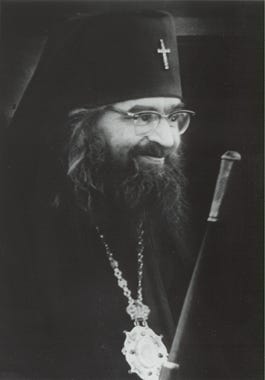
Something I want to convey from the start is that, as far as I’m aware, the Eastern Orthodox Church doesn’t definitively condemn belief in the Immaculate Conception. Yes I’m aware that John Maximovitch (d. 1966) opposed this doctrine in his infamous work, “An Orthodox Christian Understanding of the Immaculate Conception.” However, (1) this is just the opinion of one saint (remember, there are a number of early saints who opposed your own doctrine of Mary’s sinlessness as well), and (2) his arguments against the doctrine are, quite frankly, bad, and easily resolved by the articulation of the Immaculate Conception given in this article.21
More substantial are the Eastern Orthodox critics of the doctrine who point to the Council of Jerusalem 1672, Decree 6, as a pan-Orthodox authority that rejects the Marian privilege. It reads as follows:
We believe the first man created by God to have fallen in Paradise, when, disregarding the Divine commandment, he yielded to the deceitful counsel of the serpent. And as a result hereditary sin flowed to his posterity; so that everyone who is born after the flesh bears this burden, and experiences the fruits of it in this present world. But by these fruits and this burden we do not understand [actual] sin, such as impiety, blasphemy, murder, sodomy, adultery, fornication, enmity, and whatever else is by our depraved choice committed contrarily to the Divine Will, not from nature. For many both of the Forefathers and of the Prophets, and vast numbers of others, as well of those under the shadow [of the Law], as well as under the truth [of the Gospel], such as the divine Precursor, and especially the Mother of God the Word, the ever-virgin Mary, did not experience these [sins], or such like faults. But only what the Divine Justice inflicted upon man as a punishment for the [original] transgression, such as sweats in labor, afflictions, bodily sicknesses, pains in child-bearing, and, finally, while on our pilgrimage, to live a laborious life, and lastly, bodily death.
The Confession of Dositheus (Eastern Orthodox, 1672), Decree 6.
The Council of Jerusalem teaches that “the Mother of God the Word, the ever-virgin Mary,” despite being free from “[actual] sin,” nonetheless contracted “hereditary sin” as “a punishment” from Adam. That certainly sounds like a rejection of the Immaculate Conception… until you see how the “punishment for the [original] transgression” is being defined here: “sweats in labor, afflictions, bodily sicknesses, pains in child-bearing, and, finally, while on our pilgrimage, to live a laborious life, and lastly, bodily death.”
Notice that everything in this list of “punishments” pertains to the body, not the soul. The Jerusalem Council even affirms in the very next decree that our Lady was specially exempted from one of these bodily punishments, namely labor pains.22 So my question is: how does this contradict the Immaculate Conception? It doesn’t.
Remember that the Catholic dogma only pertains to the freedom of our Lady’s soul from the stain of original sin, and, in fact, depends upon her body having had the debt of original sin at some point. Thus, an affirmation that our Lady was subject to bodily curses such as sickness and death is not an affirmation that her soul was ever subject to eternal damnation.
Careful readers will also see how this reasoning resolves the difficulty raised by the Eastern Orthodox insistence on the death or dormition of the Mother of God. Since our Lady’s flesh, unlike our Lord’s, was conceived naturally and thus subject to the same debt of original sin as all descendants of Adam, her soul being preserved from contracting the stain of original sin doesn’t entail her exemption from the fleshly punishments of original sin (unless she’s specially cleansed from those, as is the case with labor pains). This is why she naturally died, as the Eastern tradition attests.
Ironically, the opinion of Elder Paisios (d. 1994) that our Lady “was all pure, because Her conception occurred without pleasure... [she was] conceived not by sexual lust, but by obedience to God,”23 is what actually undermines both Catholic and Eastern Orthodox Mariology. According to the doctrine of original sin articulated by St. Augustine and accepted at the Council of Ephesus, the concupiscence of the marital act is precisely what causes the newly conceived flesh to be stained with original sin, which in turn causes the enjoined soul to be stained as well. So if Elder Paisios were consistent, he would, in fact, have to affirm that our Lady was free of original sin in both soul and body, which would undermine her need for a Savior.
Don’t take my word for it, take it from Fr. Daniel Sysoev (d. 2009), a Russian Orthodox martyr whom many Eastern Orthodox regard as an authority. When commenting on Psalm 51:5, “In sin did my mother conceive me,” he writes, “This refers to passionate desire at the moment of conception. At that very moment man falls under the influence of sin... This sin is what is known as ancestral sin; that is, the distortion of the will, senses, and mind, which is transmitted at the moment of conception.” Thus according to Fr. Sysoev, because all men have original sin, this is why “passionless conception does not happen with the exception being the Theotokos, but she conceived without a husband. And the Theotokos herself as born with ancestral sin.”24
Clearly, when Fr. Sysoev says that our Lady’s passionless conception was “the exception,” he’s referring to her conception of Christ by the Holy Spirit, not her own conception in the womb of St. Anna. Fr. Sysoev understands that, contra Elder Paisios, if Ss. Joachim and Anna conceived the Theotokos in a passionless manner, then she wouldn’t be subject to ancestral sin at all, a position Sysoev rejects.
To illustrate just how fundamentally modern Eastern Orthodox thinkers like John Maximovitch and Elder Paisios misunderstand the Immaculate Conception, consider the brilliant Eastern Orthodox theologian Seraphim Hamilton’s (I mean that sincerely, I truly admire and respect his work) attempt to distinguish the Orthodox and Catholic views of the Marian privilege:
In one sense, original sin refers to the ontological corruption of human nature and its inherent tendency towards division and death. In the other sense, original sin refers to the movement of the will towards sin and the person’s active participation in that movement. My personal belief is that Our Lady was immaculately conceived in the latter sense but not in the former sense.
Seraphim Hamilton, “Immaculate Conception.”
In his attempt to reject the Catholic dogma, he ends up affirming it! Remember how Fr. Daniel Sysoev defined the stain of original sin that the Immaculate Conception denies to Mary: “ancestral sin; that is, the distortion of the will.” By stating that our Lady had a perfectly undistorted will from conception, Hamilton therefore accepts the Marian privilege. He’s just one example of an Eastern Orthodox Christian who, though unknowingly, already believes in the Immaculate Conception. I would encourage him to continue holding this belief, and all this article really seeks to accomplish is to encourage his fellow churchmen to do likewise.
Indeed, you would be in good Eastern Orthodox company holding firmly to the Immaculate Conception of our Lady.
Who can forget that the medieval Eastern Orthodox opponent of the Council of Florence, Gennadios Scholarios (d. 1472), taught the Marian privilege? He writes that, although “in accordance with the common laws of nature, she was not immune of the original sin,” i.e. Mary, unlike Jesus, was subject to receiving original sin on account of her natural conception,25 “the grace of God [nonetheless] delivered her completely from the original sin, as if she was conceived in a virginal manner… a privilege she alone, among men, had received.”26 While our Lord was actually conceived of a virgin, and thus needed no special grace to prevent His reception of original sin, our Lady was only “conceived in a virginal manner” by grace, and thus did need God’s redemptive intervention in order to enjoy the singular privilege of being “completely delivered of the original culpability and punishment” at conception. This accords perfectly with the doctrine of the Immaculate Conception, and Scholarios was never condemned by the Eastern Orthodox Church for holding this position.
Indeed, take special note of Scholarios’ teaching that the Immaculate Conception is “a privilege she alone, among men, had received.” That Mary has some absolutely unique relation to sin is obvious from Byzantine liturgical piety. But I would pose this question to my Eastern Orthodox readers: how can our Lady have a unique relationship to sin if she was no more cleansed of it than St. John the Baptist or the Prophet Jeremiah, both of whom were sinless from the womb?27 She can’t. The Immaculate Conception is thus the only way for Eastern Orthodox Christians to affirm the absolutely unique and singular purity of the Virgin.
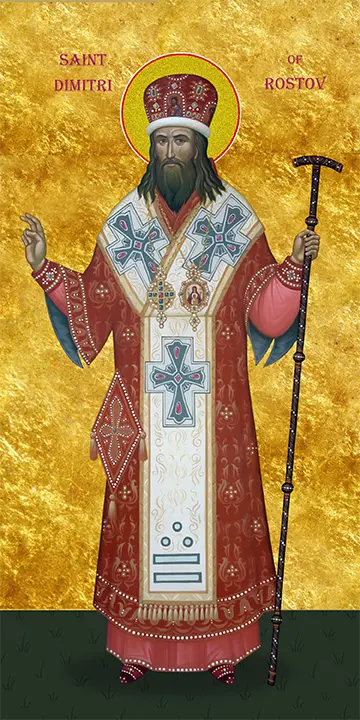
Other Eastern Orthodox saints understood this. A prominent example would be Dimitri of Rostov (d. 1709), whom some regard as “the Russian Chrysostom.” He not only taught that our Lady was unique in that she was immaculately conceived, but he even belonged to a confraternity called the “Brotherhood of the Immaculate Conception.”28 As Fr. Lev Gillet points out,29 in the 17th century, much of “the Academy of Kiev, with Peter Moghila, Stephen Gavorsky and many others, taught the Immaculate Conception in terms of Latin theology.” In the year 1667, a Council in Moscow even “approved Simeon Polotsky’s book called The Rod of Direction, in which he said: ‘Mary was exempt from original sin from the moment of her conception.’”
It therefore comes as no surprise that the Old Believers, a group that broke off from the mainstream Russian Orthodox Church during this time, has consistently defended the doctrine of Mary’s Immaculate Conception even until today.
In his excellent article, “Old Believers and the Immaculate Conception,”30 Georgios points us to Old Believer saints such as Inok Paul (d. 1854), who taught that the Theotokos “was not only completely free from original sin, but also was completely pure and very good, like heaven.” We also see others like Nikita Dobrynin (d. 1683) who were more forceful. Upon reading that certain mainstream Russian authorities were opposed to the Immaculate Conception, he wasn’t afraid to denounce them as impious heretics: “And again, regarding the Most Holy Theotokos, this is written [by the mainstream Russian theologians]: ‘the original sin was in her.’ And this is written by heretics, for the Most Holy Theotokos was sanctified from her mother’s womb and prepared as a dwelling place for God.”
To support their belief that, “the holy God-bearer possessed no defilement whatsoever even before her conception; she was holy and pure,”31 Old Believers even today cite such authorities as the Sixth Ecumenical Council, which refers to our Lady as “the immaculate Virgin Mary” and “the holy, immaculate, ever-virgin and glorious Mary.”32 They likewise appeal to St. John Damascene’s teaching that the Theotokos is “the honorable, most holy, and undefiled treasury of purity,”33 and St. Tarasius’ affirmation that the Blessed Virgin, “foreordained from the creation of the world… was and is pure and undefiled.”34 Are they wrong to do so?
At the very least, all of this demonstrates that there were many saintly and zealous men in the post-schism Eastern tradition that could see how the Immaculate Conception was implicitly contained within the Mariology of the first millennium. They fully understood the Church’s perennial belief that, to whatever extent it was possible for our Lady to have been sinless, to that extent she was, in fact, sinless. Although not every post-schism Eastern theologian arrived at the Immaculate Conception in precise terms, they’re all clearly pointing in that direction. After all, how can one be steeped in Byzantine Marian piety and not consider the possibility that there was never a point in time that she was deprived of sanctifying grace? This, I believe, lends exceptional credence to the thesis of the present article that the Catholic Church’s definition of the Immaculate Conception was a legitimate development.
I’ll leave you with this. The Russian Orthodox Church didn’t issue an official (local, not pan-Orthodox) repudiation of the Immaculate Conception until 1884,35 likely in a knee-jerk reaction to Pope Pius IX’s dogmatic definition. The appearance of our Lady of Fatima in 1917 occurred exactly 33 years later. Not only was her initial appearance (May 13th, 1917) on the Russian Orthodox feast of St. Photini (the Samaritan woman who was essentially an “old covenant schismatic”), but her public miracle of the sun happened on October 13th, 1917—at the exact time that the Russian Church was holding vigil for the Feast of the Protection of the Mother of God, which is one of the only Eastern Marian feasts that commemorates a public appearance of our Lady. The fact that our Lady of Fatima specifically desired to consecrate Russia to her Immaculate Heart, an Orthodox country with a strong history of teaching the Immaculate Conception, is thus hard to ignore. Do with that what you will.36
Further Arguments for Oriental Orthodox to Accept the Immaculate Conception
Onto the Oriental Orthodox.
For the Orientals, Fernandez points us to Jacob of Serugh (d. 521) as one of their post-schism saints who likely affirmed the Marian privilege. Although he did believe, in line with the broader Eastern Christian tradition, that it was at the Annunciation that the Holy Spirit “sanctified [Mary], purified her and made her blessed among women; [and] He freed her from that curse of sufferings on account of Eve,” this was so that Christ “might take from her a pure body without sin.”37
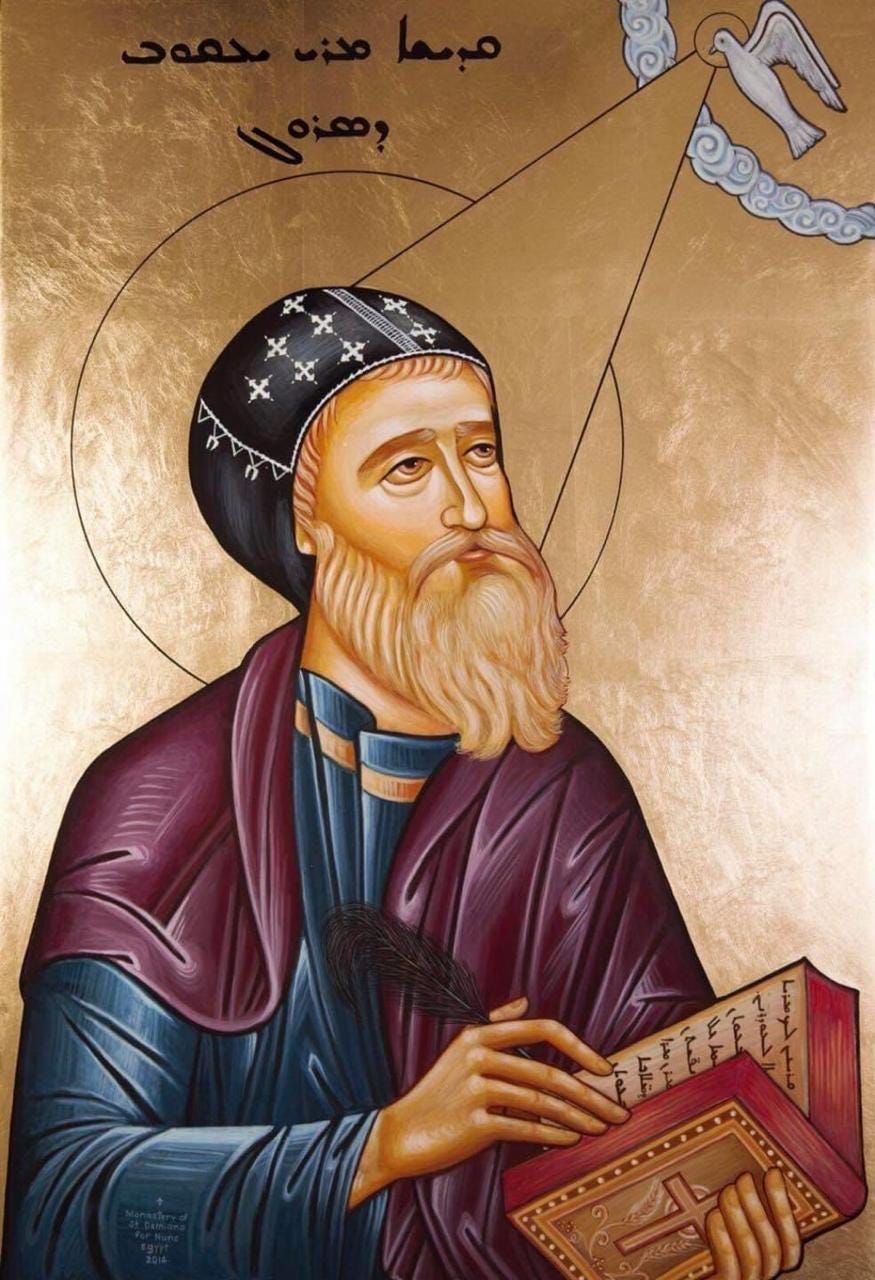
Indeed, every time Jacob discusses our Lady’s “purification” it’s with respect to her body, not her soul:
Lest the body with which He clothed Himself according to nature be sullied, He purified the Virgin by the Holy Spirit and then dwelt in her. The Son of God wanted to be related to her, and first He made her body without sin. The Word had descended that He might become flesh; on this account, by the Spirit He purified the one from whom He had become flesh, so that He might become like us in everything when He descended, except for this: that his pure body is without sin… He made her pure, limpid, and blessed as that Eve, before the serpent spoke with her.
Jacob of Serugh, Homily 1 in from On the Mother of God. Translated by Mary Hansbury, St. Vladimir’s Seminary Press, 1998, p. 35., qtd. in Kevin Fernandez, “St. Jacob of Serugh (+521) on Perfect Mary’s Holiness.”
Remember, the Immaculate Conception doctrine isn’t at all opposed to our Lady having “the curse of Eve” or even the stain of original sin in her body. Without this, there would have been nothing from which Mary could be redeemed. Instead, the doctrine states only that our Lady’s soul was always immaculate, something Jacob appears to affirm elsewhere:
She was most fair both in her nature and in her will, because she was not sullied with displeasing desires. From her childhood, she stood firm in unblemished uprightness; she walked in the way without offenses. Her original nature was preserved with a will for good things because there were always tokens of virginity in her body and holy things in her soul… Because she became the mother of the Son of God, I saw and firmly believed that she is the only woman in the world who is entirely pure. From when she knew to distinguish good from evil, she stood firm in purity of heart and in integrity of thoughts. She did not turn aside from the justice which is in the Law, and neither carnal nor bodily desire disturbed her. From her childhood, impulses of holiness stirred within her, and in her excellence, she increased them with great care,
Homily 1 in On the Mother of God. Translated by Mary Hansbury, St. Vladimir’s Seminary Press, 1998, p. 24, qtd. in Kevin Fernandez, “St. Jacob of Serugh (+521) on Perfect Mary’s Holiness.”
By stating that our Lady’s “original nature” was pure because “there were always tokens of virginity in her body and holy things in her soul,” and that “she is the only woman in the world who is entirely pure,” it’s clear that he doesn’t imagine Mary being deprived of sanctifying grace for nearly two decades between her Conception and the Annunciation. Rather, he believes that our Lady was “always” pure with respect to her soul, even though her body was still in need of cleansing. This is perfectly harmonious with the Church’s teaching on Mary’s sinless conception.
It’s also worth noting that no “magisterial” authority in the Oriental Orthodox tradition has condemned the Immaculate Conception. At most, some polemicists criticize the doctrine merely as a knee-jerk reaction to anything “western,” but there’s nothing preventing a pious Oriental Orthodox from affirming it.
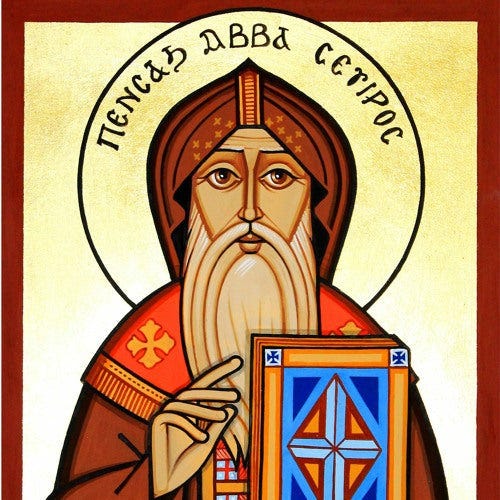
Curiously, the modern Ethiopian Orthodox Church appears to have a number of voices affirming the Marian privilege.38 At least one official source from the Eritrean Orthodox Church (which used to belong to the Ethiopian Church) states in no uncertain terms that, “The Blessed Virgin Mary was born without Adam’s original sin. She is free from original sin because She is the tabernacle of God the Son.”39 Is this really that different from Severus of Antioch’s teaching that though our Lady “formed part of the human race and was of the same essence as we,” she nonetheless “was pure from all taint and immaculate”?40
A final note for my Oriental Orthodox readers. As troublesome as it is to accept, your hero St. Cyril of Alexandria himself doesn’t perfectly align with your own tradition of our Lady being “pure from all taint and immaculate.” In his commentaries on the Gospel of St. John, Cyril confirms the teachings of Origen and St. Basil that the Virgin had sinful doubts at the Cross:
He represents, as standing by the Cross, His mother, and with her the rest, clearly weeping. For women are ever prone to tears, and very much inclined to lament, especially when they have abundant occasion for shedding tears. What, then, induced the blessed Evangelist to go so much into detail, as to make mention of the women as staying beside the Cross? His object was to teach us that, as was likely, the unexpected fate of our Lord was an offence unto His mother, and that His exceeding bitter death upon the Cross almost banished from her heart due reflection; and, besides the insults of the Jews, and the soldiers also, who probably stayed by the Cross and derided Him Who hung thereon, and who presumed, in His mother’s very sight, to divide His garments among themselves, had this effect.
For, doubtless, some such train of thought as this passed through her mind: “I conceived Him That is mocked upon the Cross. He said, indeed, that He was the true Son of Almighty God, but it may be that He was deceived; He may have erred when He said: I am the Life. How did His crucifixion come to pass? and how was He entangled in the snares of His murderers? How was it that He did not prevail over the conspiracy of His persecutors against Him? And why does He not come down from the Cross, though He bade Lazarus return to life, and struck all Judaea with amazement by His miracles?” The woman, as is likely, not exactly understanding the mystery, wandered astray into some such train of thought; for we shall do well to remember, that the character of these events was such as to awe and subdue the most sober mind. And no marvel if a woman fell into such an error, when even Peter himself, the elect of the holy disciples, was once offended.
St. Cyril of Alexandria, Commentary on John, pp. 903-4.
Cyril clearly teaches that our Lady “wandered astray” into such grievous doubts as questioning the very divinity of her Son! By these doubts she “fell into… error” just as “even Peter himself” did when he was “once offended.” For all of his praise of the Blessed Virgin, St. Cyril would unfortunately hold onto the position of Origen and St. Basil that our Lady wasn’t completely free from personal sin. Thankfully, however, Cyril would be one of the last early Christian writers to take this position, and it’s largely because of his own theological writings on the Theotokos!
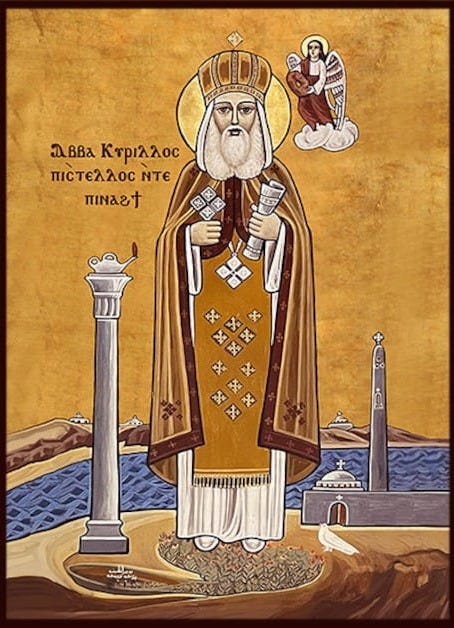
What point am I making by drawing attention to this? It’s that the Oriental Orthodox have already undergone a doctrinal development in the direction of deepening our Lady’s holiness and purity. One example that illustrates this is how sharply Severus of Antioch diverges from St. John Chrysostom in his interpretation of the wedding of Cana. Whereas Chrysostom writes, “[Christ] rebuked [Mary], saying, ‘What is this between me and you, woman?’ (John 2:4) – to instruct her, so that she would not do the same in the future,”41 Severus of Antioch reads this in the exact opposite way:
[Christ] answered [his Mother] in a very harsh tone, to give his audience a lesson, as I have said, and to teach the truth, not because he wanted to displease his Mother: “What is this between you and me, O woman? My hour has not yet come” (Jn 2:4).
His Mother herself makes it clear that these words were not a reproof but an expedient for teaching because of the presence of strangers. She does not distance herself from him or leave, in the manner of a person who has received a reproof; neither is she silent, repenting her eagerness, as happens with a person who has been censured. To the contrary, fully aware in her mind of what was going to happen, she addressed the servants as if Jesus had not said anything at all: “Do whatever he tells you” (Jn 2:5), wishing to show something greater and more befitting God.
Severus of Antioch, Homily 199; PO 26, 378-84, qtd. in Fr. Luigi Gambero. Mary and the Fathers of the Church: The Blessed Virgin Mary in Patristic Thought. Ignatius Press, 1999, pp. 340-1 [Kindle ed.].
The fact that Chrysostom has little trouble reading Jesus’ words to Mary at Cana as a “rebuke,” but Serverus goes out of his way to deny this, demonstrates that a true theological development came after the Council of Ephesus. And if the Oriental Orthodox Church’s doctrine could mature and develop once for the glory of our Lady, it follows that it could do so again given sufficient reasons. Obviously, I believe this article has provided sufficient reasons, and so I invite all of my Oriental Orthodox brethren to join me in proclaiming the Virgin Mary as the Immaculate Conception!
Conclusion
In this article I have demonstrated that the Catholic Church’s teaching on the Immaculate Conception, once properly understood, is a legitimate doctrinal development that should be affirmed by both Eastern and Oriental Orthodox Christians. Not only have all three of our Churches already developed Marian doctrine in the direction of her sinlessness, but many post-schism authorities in all of our traditions explicitly affirm that this entails our Lady’s sinless conception as well.
I truly believe that the dogma of the Immaculate Conception, in God’s Providence, serves as an ecumenical foundation from which the Eastern and Oriental Churches can draw closer to full communion with the Catholic Church. My prayer is that our Immaculate Lady brings about this full unity soon! Thanks for reading.
Council of Jerusalem 1672, Decree 6.
The Coptic Liturgy, The Commemoration Of The Saints.
Severus of Antioch, Hom., cathedralis, 67, PO, 8, 350, qtd. in Erick Ybarra, “Severus of Antioch (459-538) – Early High Mariology.”
Jacob of Serugh, Homily 1 in On the Mother of God. Translated by Mary Hansbury, St. Vladimir’s Seminary Press, 1998, p. 23, qtd. in Kevin Fernandez, “St. Jacob of Serugh (+521) on Perfect Mary’s Holiness.”
St. John Chrysostom, Homily 21 on John, n. 2-3 (PG 59, 130), qtd. in Kevin Fernandez, “The Virgin Mary’s Sinlessness in the Early Church.”
St. John Chrysostom, Homily 44 on Matthew, n. 1 (PG 57, 464-465), qtd. in Ibid.
St. Ephrem, Carmina Nisibena. 27, n. 8 Edited by Gustav Bickell. Leipzig: F. A. Brockhaus, 1866, p. 122. (CSCO 219, 76), qtd. in Ibid. It’s worth noting that, elsewhere, Ephrem also alludes to Mary having committed actual sins. See Fernandez’s article for more on that.
See Fr. Thomas Crean, “Mary as a New Eve in the Thought of St Paul.”
For a comprehensive overview of the history of this doctrine, see Daniel J. Castellano, “The Origins of Original Sin,” particularly parts III-VI.
St. Augustine, On Marriage and Concupiscence (Book II), 56.
St. Cyril, Homily XI, cited in Fr. Luigi Gambero. Mary and the Fathers of the Church: The Blessed Virgin Mary in Patristic Thought. Ignatius Press, 1999, p. 245.
See Gambero’s full treatment of St. Cyril in Ibid.
Ibid., p. 256 [Kindle ed.].
See the below section, Further Arguments for Oriental Orthodox to Accept the Immaculate Conception.
Geoffrey Dunn, “Augustine, Cyril of Alexandria, and the Pelagian Controversy,” p. 67.
Nathaniel McCallum, “Inherited Guilt in Saints Augustine and Cyril,” p. 14.
I do not intend to raise a discussion about the question of whether our Lady had concupiscence here.
“In Paradise, rebellion certainly began in the soul, whence began consent to breaking the commandment; this is why the Serpent said: ‘You shall be as gods.’ But the whole man committed the sin, and it was then that the flesh was made sinful flesh, whose faults can be healed only by the likeness of sinful flesh. In order, then, that, unless what is born be cleansed by rebirth, soul and body shall be equally punished, both are faulty when derived from man, or the one is corrupted in the other as in a faulty vessel, and this contains the hidden justice of the divine law.” (St. Augustine, Contra Julianum V, 4, 17, qtd. in Fernandez, “Did St. Augustine Believe in the Immaculate Conception of Mary?”).
This indeed seems congruent with the logic Bl. Duns Scotus was operating with in his famous defense of the Immaculate Conception: “There is an incongruity in the supposition that the flesh, from which the flesh of the Son of God was to be formed, should ever have belonged to one who was the slave of that arch-enemy, whose power He came on earth to destroy. Hence the axiom of Pseudo-Anselmus (Eadmer) developed by Duns Scotus, Decuit, potuit, ergo fecit, it was becoming that the Mother of the Redeemer should have been free from the power of sin and from the first moment of her existence; God could give her this privilege, therefore He gave it to her. Again it is remarked that a peculiar privilege was granted to the prophet Jeremiah and to St. John the Baptist. They were sanctified in their mother’s womb, because by their preaching they had a special share in the work of preparing the way for Christ. Consequently some much higher prerogative is due to Mary. (A treatise of P. Marchant, claiming for St. Joseph also the privilege of St. John, was placed on the Index in 1633.) Scotus says that ‘the perfect Mediator must, in some one case, have done the work of mediation most perfectly, which would not be unless there was some one person at least, in whose regard the wrath of God was anticipated and not merely appeased.’” (Frederick Holweck, “Immaculate Conception.” The Catholic Encyclopedia).
I’ve addressed at least one more of John’s critiques of the Marian privilege in my article, “The Immaculate Conception of Mary.”
“We believe the Son of God, Jesus Christ, to have emptied Himself, {cf. Philippians 2:7} that is, to have taken into His own Person human flesh, being conceived of the Holy Spirit, in the womb of the ever-virgin Mary; and, becoming man, to have been born, without causing any pain or labor to His own Mother after the flesh, or injury to her virginity, to have suffered, to have been buried, to have risen again in glory on the third day, according to the Scriptures, {cf. 1 Corinthians 15:3,4} to have ascended into the heavens, and to be seated at the right hand of God the Father. Whom also we look for to judge the living and the dead.” (The Confession of Dositheus (Eastern Orthodox, 1672), Decree 7).
Fr. Daniel Sysoev, Questions to Priest Daniel Sysoev, Q. 99.
Scholarios writes, “for even though her parents possessed virtue in an incomparable degree they, too, were subject to the common heritage” (Gennadios Scholarios, “On the Origin of the Human Soul,” 20, qtd. in Stephen G. Gulovich, “The Immaculate Conception in the Eastern Churches,” p. 179). This dispels the notion that Scholarios was referring to Mary being conceived “without passion” by her parents, since, in medieval theology, being “subject to the common heritage” of original sin implies passionate copulation.
Gennadios Scholarios, “On the Origin of the Human Soul,” 20, qtd. in Stephen G. Gulovich, “The Immaculate Conception in the Eastern Churches,” p. 179.
Per The Confession of Dositheus (Eastern Orthodox, 1672), Decree 6.
See Alex Roman, “The Immaculate Conception of the Mother of God in Both East and West.”
The following information is from Fr. Lev Gillet’s article, “The Immaculate Conception and the Orthodox Church.”
The following Old Believer quotes are taken from this article.
Third Council of Constantinople (A.D. 680-681). Translated by Henry Percival. From Nicene and Post-Nicene Fathers, Second Series, Vol. 14. Edited by Philip Schaff and Henry Wace. (Buffalo, NY: Christian Literature Publishing Co., 1900.) Revised and edited for New Advent by Kevin Knight.
St. John of Damascus, on the Annunciation of the God-bearer, fol. 139v, qtd. in “On the Innovations and False Teaching Introduced by Patriarch Nikon and His Successors,” Chapter 33.
An Ancient Handwritten Festal Homiliary, Homily of St. Tarasius, Patriarch of Constantinople, on the Entry of the Most Holy God-bearer, fol. 39v, qtd. in Ibid.
See Fr. Lev Gillet’s article, “The Immaculate Conception and the Orthodox Church.”
See my article, “Our Lady of Fatima,” for more.
Jacob of Serugh, Homily 1 in from On the Mother of God. Translated by Mary Hansbury, St. Vladimir’s Seminary Press, 1998, p. 34-5, qtd. in Kevin Fernandez, “St. Jacob of Serugh (+521) on Perfect Mary’s Holiness.”
See Nicholas Gulda, “Ethiopian Orthodoxy and the Immaculate Conception.”
See the Eritrean Orthodox Tewahedo Church, “The Theotokos.”
Severus of Antioch, Hom., cathedralis, 67, PO, 8, 350, qtd. in Erick Ybarra, “Severus of Antioch (459-538) – Early High Mariology.”
St. John Chrysostom, Homily 21 on John, n. 2-3 (PG 59, 130), qtd. in Kevin Fernandez, “The Virgin Mary’s Sinlessness in the Early Church.”
Note on the quotation from my article, the one who wrote this was Inok (I.e. ‘Monk’) Paul, Ambrose of Belaya Krinitsa just professed and signed off on the document during his enthronement as a Metropolitan for Belaya Krinitsa hierarchy (mainstream priestly Old-Believer hierarchy)
Great article, I will share with my EO friends. This is one of the issues that helped me return to the Catholic Church, from Orthodoxy. Love your work, it has been very helpful to me.