
There Was a Talking Snake in the Garden
The medievals on the serpent of Genesis 3

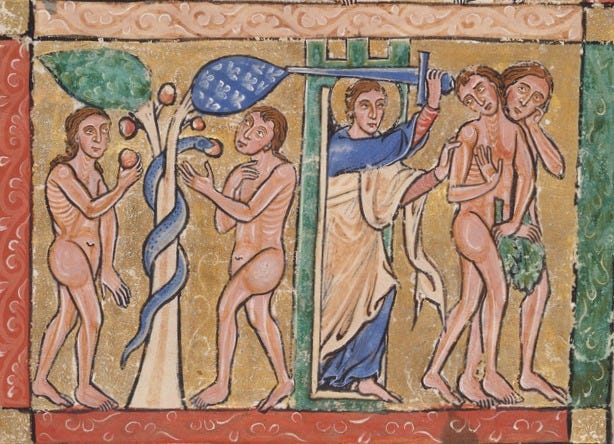
A few years ago Emmaus Academic published the Biblia cum Glossa Ordinaria – Genesis, The Great Medieval Commentary on Sacred Scripture translated by Samuel J. Klumpenhouwer. Only recently have I started seriously reading through this impressive volume, and something that immediately jumped out at me was just how literally the medievals appear to have interpreted early Genesis.
Often when we think about reading the primeval history “literally” or “symbolically” it’s with respect to matters touching on modern science, e.g. whether the days of creation were 24-hour days, whether Adam and Eve were really the first humans, etc. While much could be said about these topics, I want to focus on a “literal” interpretation that doesn’t get much attention today, but certainly did in the middle ages: the material identity of the serpent in Genesis 3.
The Gloss’ very first commentary on Genesis 3:1, “Now the serpent was more subtle, etc.,” unsurprisingly comes from St. Augustine’s De Genesi ad Litteram, book XI:
Now the serpent was more subtle, etc.: Augustine. […] The serpent can be called “the wisest” not because of its rational soul but because of its diabolic spirit. Although the bad angels fell because of their pride, by their nature they remain more excellent than all the beasts because of the excellence of their reason. It is no marvel then if the devil, filling the serpent with his spirit just as he filled the soothsayers, rendered it the wisest of all living beasts in respect to its living but irrational soul… It should not be thought that the devil himself chose the serpent through which he tempted. Rather, when the devil desired to decieve, he would have been unable were he not permitted to do so through that animal. The will of doing harm can come from oneself, but the power comes from God.
Biblia cum Glossa Ordinaria, trans. Klumpenhouwer, p. 58.
While Augustine certainly believes that “that ancient serpent” is none other than “the devil and Satan” (Rev 12:9), he also takes Genesis’ description of him as “more crafty than any other beast of the field” seriously. His explanation for how the serpent, understood as a literal animal that slithers on the ground, could be “the wisest” of all animals is not that this description is merely symbolic. Rather, it’s that this particular serpent had a “diabolic spirit” that essentially possessed it, in the same way that the devil “filled the soothsayers” with “his spirit.” This is how Satan took an otherwise dumb garden snake and “rendered it the wisest of all living beasts in respect to its living but irrational soul.”
Certainly, what a medieval student studying the Gloss would take away from this is that, among other things, there was a literal talking snake in the garden of Eden. The spirit animating this serpent was the devil, to be sure, but there is no material identity between the serpent and the devil, only a spiritual one—and both figures are understood literally.
This same interpretation is given by the very next commentary that the Gloss assigns to this passage. It’s attributed to the Benedictine monk Walafrid Strabo (d. 849), but Klumpenhouwer cites it as coming from the monk Haimo of Auxerre (d. 855). Regardless, the point remains that medieval monastics took Augustine’s literal interpretation of Genesis 3:1 to heart:
Now the Serpent, etc.: Strabo. The devil spoke this while the serpent remained unaware just as he does through possessed or fanatical persons. For whomever the devil seizes, he takes away their intellect and reason. A good spirit, on the contrary, makes whomever it chooses to fill with grace to see and understand. Hence: the spirits of the prophet are subject to the prophets (1 Cor 14:32).
Biblia cum Glossa Ordinaria, trans. Samuel J. Klumpenhouwer, p. 58.
Like Augustine, Strabo/Haimo (as well as the compilers of the Gloss) understood that the serpent in the garden was a real animal—not a symbol, not an apparition, but a literal, slithering snake. However, it was a serpent that the devil spoke through “just as he does through possessed or fanatical persons.” In other words, the devil possessed an actual serpent and used it to deceive Adam and his wife.
The Gloss doubles down on this literal interpretation of the serpent when it again cites book XI of Augustine’s De Genesi ad Litteram, this time to comment on the woman’s excuse in Genesis 3:13, “the serpent deceived me and I ate”:
The serpent deceived: Augustine. […] Note that the devil was not permitted to tempt the woman except through the serpent, nor the man except through the woman. The devil used the serpent as an organ, moving its nature to produce the sounds and words and the signs to demonstrate his will… Thus, the serpent itself did not understand the words, nor was it made rational. Serpents are drawn out from their hiding places by the words of the Marsi, but this is also a diabolical force. This is permitted as a memory of the first deed so that one can know the devil has a certain familiarity with this kind of creature. The serpent was called the most subtle because of the devil’s cunning. The devil spoke as the ass spoke to Balaam (Num 22:28), but the first case occurred through diabolic influence and the second through angelic influence. Both good and bad angels work similarly, as did Moses and the Pharaoh’s magicians (Exod 7:8-13).
Biblia cum Glossa Ordinaria, trans. Samuel J. Klumpenhouwer, p. 65.
St. Augustine’s literalist interpretation of the serpent is on full display here. He plainly says that the devil “used the serpent as an organ, moving its nature to produce the sounds and words and the signs to demonstrate his will.” Augustine once again feels the need to clarify that, in doing this, “the serpent itself did not understand the words, nor was it made rational,” instead it was “a diabolical force” that moved the serpent to talk. This explanation would only be given by someone who really believed that there was a talking snake in the garden.
Indeed, not only does Augustine state that a similar “diabolical force” was active in his own day among the Marsi, whom Klumpenhouwer states in a footnote “lived east of Rome and were famous for charming snakes,” but he even cites the story of Balaam’s donkey in Numbers 22 as another instance of preternatural power enabling an actual animal to speak. The obvious difference being that, whereas Balaam’s donkey spoke “through angelic influence,” the serpent in the garden spoke “through diabolic influence.” In both cases, though, you had talking animals.

It therefore comes as no surprise that St. Thomas Aquinas, who was familiar with an early version of the Gloss, as well as many of the patristic and medieval commentaries it made use of, held the same position regarding Genesis 3’s serpent.
In response to the question, “Whether the manner and order of the first temptation was fitting?,” St. Thomas answers that because man “is composed of a twofold nature, intellective and sensitive,” it was indeed fitting that the devil “made use of a twofold incentive to sin.” The first incentive was directed towards “the part of the intellect,” to which Satan promised “the Divine likeness through the acquisition of knowledge which man naturally desires to have.” The other was geared towards “the part of sense,” and the man and woman experienced it slightly differently. While the man was tempted “through the woman who was akin to him in the same species,” the woman was tempted “through the serpent, who was akin to them in the same genus.” Both, however, were tempted “by [the devil] suggesting to them to eat of the forbidden fruit, which was akin to them in the proximate genus.”
According to St. Thomas, the “sensitive,” i.e. carnal or fleshly dimension of the first temptation consisted in it occurring through actual, sensitive realities: a real woman, a real serpent, and a real fruit. By stating that the serpent was akin to Adam and his wife “in the same genus,” i.e. animal, Aquinas demonstrates his agreement with Augustine and the medieval Gloss that there was a real talking snake in the garden.
In fact, in response to Objection 4, “the serpent is an irrational animal. Now wisdom, speech, and punishment are not befitting an irrational animal. Therefore the serpent is unfittingly described (Genesis 3:1) as ‘more subtle than any of the beasts of the earth,’” St. Thomas simply repeats St. Augustine’s interpretation of the text:
Reply to Objection 4. According to Augustine (Gen. ad lit. xi, 29), “the serpent is described as most prudent or subtle, on account of the cunning of the devil, who wrought his wiles in it: thus, we speak of a prudent or cunning tongue, because it is the instrument of a prudent or cunning man in advising something prudently or cunningly. Nor indeed (Gen. ad lit. xi, 28) did the serpent understand the sounds which were conveyed through it to the woman; nor again are we to believe that its soul was changed into a rational nature, since not even men, who are rational by nature, know what they say when a demon speaks in them. Accordingly (Gen. ad lit. xi, 29) the serpent spoke to man, even as the ass on which Balaam sat spoke to him, except that the former was the work of a devil, whereas the latter was the work of an angel. Hence (Gen. ad lit. xi, 36) the serpent was not asked why it had done this, because it had not done this in its own nature, but the devil in it, who was already condemned to everlasting fire on account of his sin: and the words addressed to the serpent were directed to him who wrought through the serpent.”
St. Thomas Aquinas, Summa Theologiae, II-II, Q. 165, A. 2.
Like Augustine, Aquinas affirms that the serpent’s soul wasn’t “changed into a rational nature” by the devil, rather “the serpent spoke to man, even as the ass on which Balaam sat spoke to him, except that the former was the work of a devil, whereas the latter was the work of an angel.” Clearly, Ss. Augustine and Thomas are in absolute lock-step on this interpretive point.

In our modern theological climate where one can’t begin to comment on early Genesis without a quasi-ritualistic denunciation of “literalism,” it was refreshing for me to read these medieval perspectives on the sacred text. Even if the presence of a talking snake in the garden isn’t among the most important issues when it comes to interpreting Genesis, I do believe that it can serve as a kind of litmus test. If one’s immediate instinct is to denounce this interpretation as “simplistic” or “un-academic,” then it should at least cause him to question where that instinct is coming from, and whether or not it’s the same pious instinct that motivated Ss. Augustine and Thomas in their study of Sacred Scripture.
I’ll leave you with this. When considering the question of how the woman could have ever been convinced of the devil’s false promises in the garden, the Gloss quotes St. Augustine’s striking answer:
The serpent deceived: Augustine. How could she have been convinced by these words (For God doth know that in what day soever, etc.) that God had banned her from a good and useful thing unless there were already present in her mind a love of her own power and a proud presumption of herself which through sin would be found out and destroyed? Indeed, not content with the persuasion of the serpent, she gazed upon the tree as good to eat and delightful to behold. Not believing she could thence die, perhaps she thought that God had figuratively said: if you eat of it, you shall die the death. Thus, she did eat, and gave it to her husband, perhaps using some persuasion which Scripture left to be assumed. Or perhaps no persuasion was necessary since Adam saw that she did not die from the fruit.
Biblia cum Glossa Ordinaria, trans. Samuel J. Klumpenhouwer, p. 65.
For Augustine and the medievals, it was the woman’s “proud presumption of herself,” her own power, her own mind, that led her to doubt the clear word of God. It was this pride that led her to think that, perhaps, God had only “figuratively said” that she and Adam would die upon eating the fruit. Is it unreasonable to suppose that modern man falls into a similar trap? So proud of his own scientific intellect, his own technological power, what other clear teachings from God might he wish to downplay as mere figurative language? A question to ponder for sure.
Our first parents fall. She blames the serpent; he blames "the woman whom thou gavest me..." (Gen. 3, 11) Each of them, instead of confessing his guilt and asking for pardon, blames another for the sin: the prototype of everything that ever went wrong between man and woman (and for every reality cop show).
How did you stumble into such an obscure and erudite pursuit? Carry on, sir.