
Days Before the Sun?
Responding to a classic objection to Genesis 1

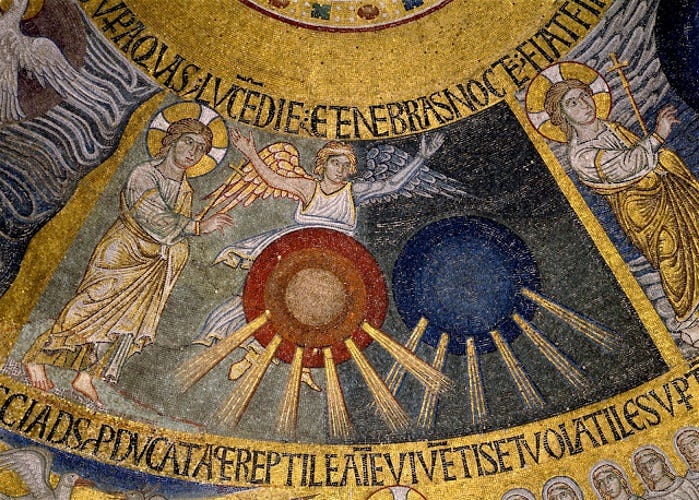
There’s a popular argument against the literal interpretation of “days” in Genesis 1 that goes like this: Genesis 1:1-13 describes three “days” consisting of “evening” and “morning.” Yet this is prior to the creation of the sun, moon, and stars in Genesis 1:14-19. Clearly, this indicates that either the author of Genesis (Moses) was foolish, or that he understood “day” symbolically and not as a literal 24-hour period.
I hear this line of reasoning all the time. It even made its way into the latest Ignatius Catholic Study Bible put out by Scott Hahn and friends. But it’s a bad argument. In fact, not only is it wrong, but it actually ends up missing an important theological point that Moses wanted to communicate.
Let’s think through this. In Genesis 1:3-5, God creates “light” that He calls “day,” and then “darkness” that He calls “night.” This is what allows there to be “evening and... morning, the first day.” On the fourth day, God creates the sun, moon, and stars, and charges them “to rule over the day and over the night, and to separate the light from the darkness” (Gen 1:18). The pattern is this: God first creates a realm that He directly governs Himself—light and darkness, day and night—and then hands over the government of this realm to created intermediaries—the sun, moon, and stars.
This pattern foreshadows the creation of man. In Genesis 1:1, God first creates “the earth,” which He Himself governs by forming and filling it with life (Gen 1:1-25). However, on the sixth day, “God said, ‘Let us make man in our image, after our likeness. And let them have dominion over... the earth’” (Gen 1:26). God first creates the earth, directly forms and fills it Himself, and then hands over this “dominion” to mankind, charging men and women to continue His project of forming and filling the earth with new life (Gen 1:28).
Just as God had commanded the sun, moon, and stars to continue to “separate the light from the darkness,” as He had once done Himself, so now does He charge mankind to “be fruitful,” as He had once done Himself. Indeed, one may conclude that just as the “earth” over which mankind has dominion is the same earth that God alone initially governed, so too are the “day” and “night” over which the heavenly bodies rule the same day and night that God alone initially ruled—24-hour cycles of “light” and “darkness.”
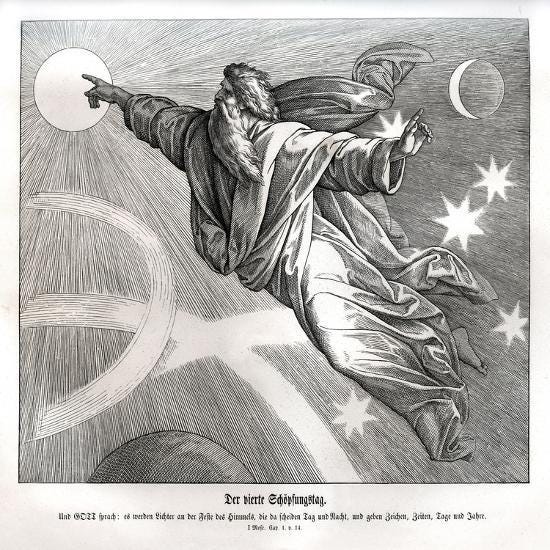
As I pointed out in an old article, “The Heavenly Lights,” this connection between mankind and the heavenly bodies is intentional. The sun, moon, and stars represent men—ruling the heavens just as man rules the earth. This is why “signs” in the “heavens” often reflect changes in mankind’s political dominion, especially when it’s of eschatological significance (Matt 24:29; cf. Mk 13:24-25; Lk 21:25). This is why “the ruler of this world” who is “cast out” is described as the “sign” of the “dragon” in the “heavens” (Rev 12:3). If that’s not a Zodiac sign then I don’t know what is.1 He even “swept down a third of the stars of heaven and cast them to the earth” before being cast down himself (Rev 12:4).
Those who rule, even if they’re wicked, are symbolized by the heavenly bodies. This symbolic grammar was setup in Genesis 1. The sun, moon, and stars were the first of God’s creatures to exercise dominion over a realm that He once ruled alone—day and night. Why else would they, and not mankind, occupy the fourth day, the center of the Creation Week? They were the first rulers, we came second.
In the end, however, the dominion that the heavenly bodies have over day and night will be transferred one last time: “the [heavenly] city has no need of sun or moon to shine on it, for the glory of God gives it light, and its lamp is the Lamb” (Rev 21:23). The sun, moon, and stars were never meant to rule the heavens forever, we were. This is why, one day, the saints of the Lamb “will shine like the bright expanse of the heavens… like the stars forever and ever” (Dan 12:3), fulfilling the promise to Abraham that his descendants would be “as the stars of heaven” (Gen 26:4).
See my article, “Astrology in the Bible.”
We can also add in the different language used at the end of 1:5. The other days are "second day, third day" etc. But not day one. While most translations give is as a sequential "first day" the Hebrew literally says, "Day one" (יוֹם אֶחָד). Echad carries the idea of unity, completeness, wholeness. It is a singular, composite unity. It is the word used in the Shema. Reshon is the Hebrew for "first" and that isn't what's used. The echad is what the man is later missing, and what is supplied to him by the creation of the woman.
Disappointing to hear that the Ignatius Bible caves in to secular scientism rather than believe the Word of God. But, that's expected of the professional Catholic apologentsia class these days, whose combination of faithlessness and embarrassment emboldens them to accept and proclaim every modern scientific theory under the guise of the tired mantra, "faith and science are not in conflict."
They say this all the time, but what they mean is that they'll accept things like evolution, belief in aliens, and an old earth, and then try to shoehorn Scripture into supporting these views. They make Genesis subservient and secondary to secular academia, then proudly claim that faith and reason are in harmony with each other. They will insist that we must be humble and not force Scripture to mean something it doesn't, but they themselves do not have the humility to accept God's word as it is written.
Indeed, one of the best ways to become skeptical of the faith and lose interest in the Church is by listening to these fools who call themselves "apologists."