
Ending the "Empty Honorifics" Argument Against the Papacy
The truth about the papal claims of the first millennium

Introduction
There’s been much online commentary concerning the (now somewhat) recent debate between my friend Elijah Yasi and the Eastern Orthodox apologist Alex Sorin. I haven’t been able to watch all of the “debate reviews” that have happened subsequently, nor do I intend on turning this article into some kind of debate review. However, I did want to address a topic that was prominent in Sorin’s opening statement, rebuttal, and much of the cross-examination: “empty honorifics.”
Alex made the bold claim that, “for almost every quote [in the early Church] exalting Rome, there’s a corresponding quote to other major Sees.” That is to say, for nearly every father or council you find interpreting Matthew 16, John 21, and Luke 22 as meaning that St. Peter and his successors in Rome will head the Church until the end of time,1 you can apparently find a corresponding quote that applies similar logic to a See other than Rome. This proves, so the argument goes, that all of the ancient councils and fathers who exalted the Roman pontiff were just flattering him with (ultimately) meaningless language. After all, if everyone is the supreme and divinely instituted head of the Catholic Church, then no one is.
This is the argument that Mr. Sorin attempted to prove in his debate with Mr. Yasi. To do so, he produced a florilegium of about ten quotes from antiquity that are said to describe men other than the pope as the divinely instituted heads of the Church. In this article, I will unpack every single quote that Sorin cites in his favor and explain why none of them truly constitute “empty” or “meaningless” honorifics. I will then take a detailed look at the papal claims in the first millennium and explain how these claims are different from the quotes cited by Sorin. In the end, I hope to demonstrate that when every quote under dispute is read in its proper context, and the truth being communicated is actually understood, there’s an obvious distinction between the papal claims and what’s dismissed as “empty honorifics.”
Alleged “Empty Honorifics”
St. Ignatius’ Epistle to the Philadelphians
The first quote that Sorin enlists in his favor comes from St. Ignatius of Antioch’s Epistle to the Philadelphians. Sorin claims that here Ignatius teaches the divine institution of the Church of Philadelphia: “the Church of God the Father, and our Lord Jesus Christ, which is at Philadelphia, in Asia, which has obtained mercy, and is established in the harmony of God.” Although Sorin doesn’t directly state his logic, it seems to be something like this: “Clearly, Ignatius didn’t really believe that the Church of Philadelphia was ‘divinely instituted,’ this was just an empty honorific. So too, no one really believed that Rome’s primacy was of divine origin, that was just an empty honorific.” But this is a bad argument for multiple reasons.
First, Ignatius doesn’t quite say that the Church of Philadelphia was “established by God” in reference to her founding. Instead, he says that the Church is currently “established in the harmony of God,” which seems to refer to her active fidelity to Jesus through union with her bishop. My question is, how was that an empty honorific? It was just true. Since the Holy Spirit alone brings the peace and unity of Christ into our midst, it’s perfectly acceptable to say that God Himself has literally “established” a faithful Church “in harmony.” It’s not as if the will of man is capable of such a feat. So how does Sorin envision this quote as proving that everyone in the early Church was just saying things that they didn’t really mean? I’m not sure.
Second, even if Ignatius did say something like, “the Church of Philadelphia was established by God,” and even if he went on to say something like, I don’t know, “whoever rebels against” the bishop of Philadelphia “is rebelling against what God has instituted,” would that really be an empty honorific? Consider what St. Paul the Apostle wrote about the first century Roman Empire:
Let every person be subject to the governing authorities. For there is no authority except from God, and those that exist have been instituted by God. Therefore whoever resists the authorities resists what God has appointed, and those who resist will incur judgment.
Romans 13:1-2
Could you imagine if St. Ignatius of Antioch said something like this about the bishop of Philadelphia? There’s no doubt that Sorin would have taken such a quote as a “clear” and “undeniable” example of an empty honorific that doesn’t covey anything of serious theological consequence. However, since this quote is literally in the Bible and talking about civil authority rather than ecclesiastical authority, it makes sense why Mr. Sorin didn’t think to use it in his presentation.
Certainly, St. Paul would have been baffled by someone dismissing his words in Romans 13 as “empty honorifics.” Texts like Acts 22 and 25 reveal that the Apostle’s belief in the divinely instituted authority of Rome had a real impact on the way he conducted himself as a subject of the Empire. It was not an empty honorific. Mr. Sorin’s appeal to St. Ignatius in an attempt to dismiss all of the papal claims as “empty honorifics” thus leaves me quite baffled.
St. Ignatius’ Epistle to the Ephesians
The next quote Sorin appeals to in an attempt to prove his “empty honorifics” thesis is even more peculiar. He points to St. Ignatius’ comment that the Church of Ephesus is “predestinated before the ages of time, that it should be always for an enduring and unchangeable glory.”2 But once again, Sorin doesn’t directly state what conclusion he’s drawing from this text. Is it that Ignatius didn’t believe in the predestination of the Ephesian Church to eternal glory? And somehow this means we can dismiss later papal claims as being ultimately meaningless as well? How does that follow?
Moreover, one truly has to wonder if Mr. Sorin is aware of just how dependent upon the Apostle Paul our father St. Ignatius of Antioch was:
Blessed be the God and Father of our Lord Jesus Christ, who has blessed us in Christ with every spiritual blessing in the heavenly places, even as he chose us in him before the foundation of the world, that we should be holy and blameless before him. In love he predestined us for adoption to himself as sons through Jesus Christ, according to the purpose of his will, to the praise of his glorious grace, with which he has blessed us in the Beloved. […] In him we have obtained an inheritance, having been predestined according to the purpose of him who works all things according to the counsel of his will, so that we who were the first to hope in Christ might be to the praise of his glory.
Ephesians 1:3-6, 11-12
The Apostle Paul wrote this to the same Ephesians not very long before Ignatius. It’s therefore likely that St. Ignatius wrote what he did to the Ephesians to remind them of what St. Paul had taught them just a few decades before about their predestination to eternal glory. To suppose, as Sorin does, that this is all “empty honorifics” is not only incorrect, but I would even say it’s insulting to St. Ignatius and St. Paul themselves.
St. Ignatius’ Epistle to the Smyrnaeans
Alex’s next argument from St. Ignatius is more egregious. He quotes the beginning of The Epistle of Ignatius to the Smyrnaeans, of which he has a strange translation:
Ignatius, who is also God-carrier, to the Church of God the Father and the Beloved Jesus Christ, which has received mercy in every good gift, which is filled in faith and love, which is second to none in every good gift, which is most worthy of God.
In bold are the words which Sorin himself bolded and underlined in his presentation. I’m honestly not sure where Sorin got this translation from, I couldn’t find it anywhere online. But since he makes a big deal about the Church of Smyrna being “second to none” (Alex repeats this phrase three times), it’s worth pointing out that this particular phrase isn’t one that Ignatius actually used.
The Greek phrase in question is ἀνυστερήτῳ οὔσῃ παντὸς χαρίσματος,3 which literally translates to, “being lacking in no gift.” While “second to none” isn’t a horrendous translation, it’s still an idiomatic or interpretive one, i.e. not literal. The translation found in the Ante-Nicene Fathers is more representative of the original Greek:
Ignatius, who is also called Theophorus, to the Church of God the Father, and of the beloved Jesus Christ, which has through mercy obtained every kind of gift, which is filled with faith and love, and is deficient in no gift, most worthy of God, and adorned with holiness: the Church which is at Smyrna, in Asia, wishes abundance of happiness, through the immaculate Spirit and word of God.
Translated by Alexander Roberts and James Donaldson. From Ante-Nicene Fathers, Vol. 1. Edited by Alexander Roberts, James Donaldson, and A. Cleveland Coxe. (Buffalo, NY: Christian Literature Publishing Co., 1885.) Revised and edited for New Advent by Kevin Knight. <http://www.newadvent.org/fathers/0109.htm>.
This makes Sorin’s rhetorical point about this text quite problematic. He asks, “Wait, I thought Rome had the most powerful spiritual gift. Did [Ignatius] forget about the gift of infallibility in Rome?” Sorin makes this argument because he thinks St. Ignatius calls the Church of Smyrna’s gifts “second to none” in comparison with other Churches. However, as noted, this “comparison” of Smyrna with other Churches isn’t actually in the Greek text, it’s an invention of whoever translated Sorin’s version of the text into English. This is what happens when apologists care more about scoring rhetorical points than doing careful research.
Indeed, if Sorin paid more attention to what St. Ignatius wrote in his epistle to the Smyrnaeans, he might have noticed that this particular passage has a parallel in the writings of (surprise surprise) St. Paul:
I give thanks to my God always for you because of the grace of God that was given you in Christ Jesus, that in every way you were enriched in him in all speech and all knowledge— even as the testimony about Christ was confirmed among you— so that you are not lacking in any gift, as you wait for the revealing of our Lord Jesus Christ, who will sustain you to the end, guiltless in the day of our Lord Jesus Christ. God is faithful, by whom you were called into the fellowship of his Son, Jesus Christ our Lord.
1 Corinthians 1:4-9
Why didn’t Sorin quote this biblical text as an example of “empty honorifics”? Its language is clearly what inspired St. Ignatius, just compare the two:
St. Ignatius: ἀνυστερήτῳ οὔσῃ παντὸς χαρίσματος, “being lacking in no gift.”
St. Paul: ὑστερεῖσθαι ἐν μηδενὶ χαρίσματι,4 “lacking in not one gift.”
The answer is obviously because Sorin knows (at least he should) that St. Paul didn’t encourage the Corinthians with empty honorifics. When he told them that they “lacked no gift” in preparation for the coming of our Lord, he meant it. As Paul wrote to the Ephesians, God the Father “has blessed us in Christ with every spiritual blessing in the heavenly places” (Eph 1:3), which allows us to stand with confidence in the face of the coming “day of redemption” (cf. Eph 4:30). This has nothing to do with the “gift” or “grace” of ecclesiastical authority, rather it has everything to do with the spiritual gifts and blessings that our Father has bestowed on us in Christ.
In fact, in his Epistle to the Smyrnaeans, Ignatius never refers to the jurisdictional or teaching authority of any bishop as a “gift” or “grace.” The corporal works of mercy represent “the grace of Christ,”5 partaking of the Holy Eucharist is a “gift,”6 the laity’s obedience to their bishop happens “through grace,”7 it is “by the grace of God” that Ignatius will “attain God,”8 and so forth. In the context of this letter, Ignatius intends the word “gift” or “grace” to be understood as a spiritual blessing that interiorly sanctifies the faithful followers of our Lord. Like St. Paul, he’s not using that term to designate ecclesiastical prerogatives. The fact that Sorin didn’t realize any of this as he was preparing for this debate isn’t a great look.
St. Ignatius’ Epistle to St. Polycarp
The last argument from St. Ignatius that Sorin makes is perhaps his weakest. St. Ignatius writes to St. Polycarp: “Ignatius, who is also called Theophorus, to Polycarp, Bishop of the Church of the Smyrnæans, or rather, who has, as his own bishop, God the Father, and the Lord Jesus Christ.”9 The conclusion Sorin draws from this is, and I quote, “St. Ignatius says that the only bishop above St. Polycarp is God the Father and the Lord Jesus Christ. So I mean I guess he forgot also about the universal jurisdiction and supremacy about the bishop of Rome.” This argument really is indefensible.
First, Ignatius does not say that “the only bishop above St. Polycarp is God.” That word “only” isn’t even present in Sorin’s translation. Second, when St. Peter the Apostle wrote to his flock, “now you have returned to the Shepherd and Bishop of your souls” (1 Pet 2:25), i.e. the Lord Jesus Christ, was he denying his own episcopal authority over them? Clearly not. Affirming that God Himself is someone’s true Shepherd is an affirmation of their personal sanctity, not their ecclesiastical rank. Once again, this isn’t an empty honorific. St. Ignatius really believed in the personal sanctity of St. Polycarp. The fact that this didn’t occur to Sorin before publicly presenting this argument is a bit surprising.
St. Basil’s Letter 66 to St. Athanasius
After St. Ignatius of Antioch, Sorin then sets his sights on St. Basil the Great. He presents the following quote that one will find quite often on Eastern Orthodox apologetics blogs and YouTube channels:
[W]hat part is more vital to the Churches throughout the world than Antioch? Only let Antioch be restored to harmony, and nothing will stand in the way of her supplying, as a healthy head, soundness to all the body.
St. Basil, Letter 66.
In Sorin’s words, “St. Basil the Great says that Antioch is the head of the whole body… now what could be more vital to the churches of the world, the whole world, than the church of Antioch… So Antioch is the head, Rome is the body.” What do we Catholics have to say to this? Doesn’t this quote from St. Basil prove that, in antiquity, anyone and everyone was called “the head” of the Church? Doesn’t this mean that nobody was serious about the Roman pontiff being “the holy head” of all other bishops on account of the fact that “the head of the Apostles, is blessed Peter the Apostle”?10 No.
Let’s look at this quote from St. Basil with the relevant context:
No one, I feel sure, is more distressed at the present condition, or, rather to speak more truly, ill condition of the Churches than your excellency [St. Athanasius…]; for you compare the present with the past, and take into account how great a change has come about. You are well aware that if no check is put to the swift deterioration which we are witnessing, there will soon be nothing to prevent the complete transformation of the Churches. And if the decay of the Churches seems so pitiful to me, what must — so I have often in my lonely musings reflected — be the feelings of one who has known, by experience, the old tranquillity of the Churches of the Lord, and their one mind about the faith? […]
I for my part have long been aware, so far as my moderate intelligence has been able to judge of current events, that the one way of safety for the Churches of the East lies in their having the sympathy of the bishops of the West. For if only those bishops liked to show the same energy on behalf of the Christians sojourning in our part of the world which they have shown in the case of one or two of the men convicted of breaches of orthodoxy in the West, our common interests would probably reap no small benefit, our sovereigns treating the authority of the people with respect, and the laity in all quarters unhesitatingly following them. But, to carry out these objects, who has more capacity than yourself, with your intelligence and prudence? Who is keener to see the needful course to be taken? Who has more practical experience in working a profitable policy? Who feels more deeply the troubles of the brethren? What through all the West is more honoured than your venerable gray hairs? […]
For the rest of the affairs of the East perhaps you may need the aid of more, and we must wait for the Westerns. But plainly the discipline of the Church of Antioch depends upon your reverence’s being able to control some, to reduce others to silence, and to restore strength to the Church by concord. No one knows better than you do, that, like all wise physicians, you ought to begin your treatment in the most vital parts, and what part is more vital to the Churches throughout the world than Antioch? Only let Antioch be restored to harmony, and nothing will stand in the way of her supplying, as a healthy head, soundness to all the body. Truly the diseases of that city, which has not only been cut asunder by heretics, but is torn in pieces by men who say that they are of one mind with one another, stand in need of your wisdom and evangelic sympathy.
St. Basil, Letter 66.
In this letter, St. Basil is imploring St. Athanasius for help during the height of the Arian crisis. He correctly notes that “the one way of safety for the Churches of the East lies in their having the sympathy of the bishops of the West.” Since Athanasius was well known in the West as a champion of Nicene orthodoxy, Basil believed that his moral authority was crucial for securing western assistance.
Why did the East need the West’s support? Because, according to Basil, the West wasn’t really having any problems of its own. Unlike the East, the West wasn’t overrun with heretics and schismatics. Hence Basil humorously remarks, “if only those bishops [in the West] liked to show the same energy on behalf of the Christians sojourning in our part of the world [the East] which they have shown in the case of one or two of the men convicted of breaches of orthodoxy in the West.” The point is, orthodoxy was so secure in the West headed by Pope St. Damasus that the bishops there were more capable of acting as a unified front to oppose the heresies and schisms of the East.
This is when Basil turns his attention to the specific problems in the East. Since the Arian crisis was still raging, it was more important than ever for the Eastern Churches to unite against it. However, this is precisely what wasn’t happening in the prominent Church of Antioch, and by consequence, all of the Eastern Churches under its influence. Indeed, consider how Basil begins his letter to Athanasius by lamenting the “ill condition of the Churches,” “the swift deterioration… of the Churches,” and “the decay of the Churches,” after which he declares his longing for “the old tranquility of the Churches of the Lord.” Which Churches are being referred to here? It’s not the Churches of the West, which were doing just fine according to St. Basil. It’s not even all of the Churches of the East, as Alexandria was doing quite well with none other than St. Athanasius as their patriarch. Instead, Basil is referring to the Eastern Churches whose stability and orthodoxy was being threatened by the heresies and divisions in Antioch.
“The diseases of that city,” writes Basil, are more numerous than ever. Not only has the Church of Antioch been “cut asunder by heretics,” but it’s also been “torn in pieces” by the so-called Meletian schism. This was concerning because, at that time, Antioch was the highest See in Christendom that remained an Arian stronghold. By stating that Antioch is the most “vital to the Churches throughout the world [οἰκουμένην],”11 Basil indicates his fear that, if Antioch falls, Arianism could spread like a kind of cancer to the entire ecumene. Given the influence that Antioch had over the East, Basil perhaps imagines a frightful world in which Arians control the third highest See in Christendom,12 and from there start threatening the stability of the those areas of the empire that were Nicene.
With this context it’s obvious that, contra Mr. Sorin, St. Basil wasn’t lauding the Church of Antioch with “empty honorifics.” Basil doesn’t actually have anything nice to say about Antioch at all. When he states that Antioch can, “as a healthy head,” supply “soundness to all the body,” he’s merely continuing his medical analogy from the previous sentence: “like all wise physicians, you [Athanasius] ought to begin your treatment in the most vital parts.” Basil truly believed that, if Antioch fell, its diseases would spread to the entire empire—like a man’s diseased head infecting his body. Given the seriousness and urgency with which he appeals to Athanasius, it’s strange to suppose that Basil was engaged in “meaningless flattery” by this language.
The fact that apologists like Sorin can see Basil’s words, “what could be more vital to the churches of the world, the whole world, than the church of Antioch,” and conclude (even if insincerely), “So Antioch is the head, Rome is the body,” merely demonstrates that they didn’t read the entire letter. To understand why, let’s suppose that Basil’s use of the term “head” truly does indicate a sort of ecclesiastical authority. Now consider that the purpose of this head is to supply “soundness to all the body.” One simply has to ask, for St. Basil, who supplies “soundness” to the Church of Antioch? Recall his medical analogy: “like all wise physicians, you [Athanasius] ought to begin your treatment in the most vital parts, and what part is more vital to the Churches throughout the world than Antioch?” For Basil, Athanasius is the “physician” who needs to “treat” the “diseases” in Antioch. He literally says that “the discipline of the Church of Antioch depends upon your reverence’s being able to control some.” Antioch “depends upon” Athanasius’s Alexandria. Alexandria is thus the “head” See that provides “soundness” to the “body” of Antioch, not the other way around.
The same could be said about Rome. After all, according to Basil, “the one way of safety for the Churches of the East lies in their having the sympathy of the bishops of the West.” When further speaking about “the affairs of the East” he goes on to say that “we must wait for the Westerns.” Not only is the West (whose head is Rome) capable of supplying “soundness” to Antioch, but to all of the Eastern Churches as well. This is the reason why Basil asks for Athanasius’ help in securing western assistance to begin with. Indeed, if we suppose that Basil’s reference to “headship” in this letter implies ecclesiastical authority, then the picture we get is this: Rome is the head over the East, Alexandria is the head over Antioch, and Antioch is the head over the rest of the empire. This ends up cohering perfectly with the pre-Constantinopolitan ranking of the Churches of Rome, Alexandria, and Antioch.13 I’m not sure that Basil actually had this traditional ranking of the apostolic Sees in mind—this is perhaps an area for further study—but I couldn’t help but notice the pattern.
Ultimately, however you slice it, it’s simply impossible to read St. Basil as suggesting that Antioch is the head over Rome or Alexandria. Likewise, it betrays the context of Basil’s letter to read it as insincerely flattering Antioch with empty honorifics. In reality, this letter doesn’t contain any praise of Antioch at all, only lament.
Now, Mr. Sorin is certainly correct that texts like this help Catholics see that we can’t just look at someone being called “the head of the whole world” and derive Vatican I therefrom. As I’ll explain later in this article, that’s not what Catholics have to do in order to defend the papacy. Rather, we have to consider each quote on a case-by-case basis, pay close attention to the context (both immediate and historical), and actually try to understand what the author is communicating. Given Sorin sped through ten quotes in less than four minutes, it’s no wonder that he didn’t do any of this, and therefore didn’t truly understand any of the quotes he used in the debate.
St. Basil’s Letter 67 to St. Athanasius
Having misunderstood St. Basil’s first letter to St. Athanasius, it makes sense that Sorin would misread Basil’s follow-up letter as well.
St. Basil begins Letter 67 by explicitly affirming that this is a continuation of his “former letter.” Apparently he didn’t make his support for St. Meletius in particular clear enough. In other words, the only thing Basil intends on adding to what he wrote in his previous letter is the specific name of Meletius. Let’s look at the entire letter (it’s very short) and see where Sorin goes wrong in interpreting it:
In my former letter it seemed to me sufficient to point out to your excellency, that all that portion of the people of the holy Church of Antioch who are sound in the faith, ought to be brought to concord and unity. My object was to make it plain that the sections, now divided into several parts, ought to be united under the God-beloved bishop Meletius. Now the same beloved deacon, Dorotheus, has requested a more distinct statement on these subjects, and I am therefore constrained to point out that it is the prayer of the whole East, and the earnest desire of one who, like myself, is so wholly united to him, to see him in authority over the Churches of the Lord. He is a man of unimpeachable faith; his manner of life is incomparably excellent, he stands at the head, so to say, of the whole body of the Church, and all else are mere disjointed members. On every ground, then, it is necessary as well as advantageous, that the rest should be united with him, just as smaller streams with great ones. About the rest, however, a certain amount of management is needed, befitting their position, and likely to pacify the people. This is in keeping with your own wisdom, and with your famous readiness and energy. It has however by no means escaped your intelligence, that this same course of procedure has already recommended itself to the Westerns who are in agreement with you, as I learn from the letters brought to me by the blessed Silvanus.
St. Basil, Letter 67.
Of course, Sorin highlights Basil’s comment that Meletius “stands at the head, so to say, of the whole body of the Church, and all else are mere disjointed members,” and says, ah ha! See? Everyone and anyone in antiquity was called “the head of the Church,” there’s nothing special about Rome being the head. It’s all empty honorifics, mere flattery, it doesn’t actually mean anything of consequence. But is that true?
No. Above it was already shown how St. Basil essentially denied the Church of Antioch being a head over the Western Churches, and instead affirmed that the entire East (including Antioch) depended upon the West. He likewise denied that other Eastern Churches such as Alexandria depend on Antioch, and instead affirmed the exact opposite. Thus, if Basil envisions the patriarch of Antioch as “the head” of “the whole body of the Church,” this would be referring to his headship over the Eastern Churches in Basil’s area, and this headship was no mere honorific.
However, in this specific context, I’m not even sure that that’s what Basil is talking about. He writes that St. Meletius “is a man of unimpeachable faith; his manner of life is incomparably excellent, he stands at the head, so to say, of the whole body of the Church, and all else are mere disjointed members.” Basil seems to be describing the personal qualities of the man Meletius, more so than the ecclesiastical prerogatives of the See of Antioch. Meletius’ “unimpeachable faith” and “manner of life” are so “excellent” that everyone can look up to him as a faithful leader to follow. Basil is likely contrasting St. Meletius with his “rival” St. Paulinus of Antioch, trying to show that the former is so holy and so widely acclaimed that he’s already acting as a unifying “head” behind which the Nicene East can rally. Indeed, the fact that Basil’s previous letter had nothing but negative things to say about Antioch, and this letter has nothing but positive things to say about Meletius, supports this interpretation that Letter 67 speaks to Meletius’ personal qualities, not ecclesiastical prerogatives.
I’m a little surprised that Sorin didn’t quote the immediately preceding sentence, wherein Basil states that he and everyone in the East longs “to see [Meletius] in authority over the Churches of the Lord.” Maybe whatever florilegium Sorin got this quote from didn’t include that part. Regardless, that quote seems like a more direct reference to the ecclesiastical authority of Antioch than the one Sorin highlighted. Yet read the full context: “it is the prayer of the whole East, and the earnest desire of one who, like myself, is so wholly united to him, to see him in authority over the Churches of the Lord.” Once again, this isn’t an empty honorific. Basil and those like him in his jurisdiction truly wished to see Meletius as the authoritative head of the third highest See in Christendom. Basil already alluded to this in his previous letter, to which this current letter is a mere addendum.
St. Basil’s Letter 69 to St. Athanasius
Alex goes on to quote yet another letter that St. Basil wrote to St. Athanasius in an attempt to prove that “everybody [in antiquity] talks about everyone” as if they’re the supreme rulers of the Church (but no one really believes that, of course). Once again, I’m not sure which translation Sorin is using, but the standard Nicene and Post-Nicene Fathers translation actually steel-mans Sorin’s argument, so I’ll quote from that:
With the object of offering some contribution to the action which is being taken in this matter, I have thought that I could not make a more fitting beginning than by having recourse to your excellency [Athanasius], as to the head and chief of all, and treating you as alike adviser and commander in the enterprise.
St. Basil, Letter 69.
First St. Meletius is the head of the “whole world,” now St. Athanasius is the “head and chief over all,” next thing you know, Basil himself might be the supreme pastor of the known universe! That is, of course, if you don’t realize what Basil is saying in context. Once again, let’s look at the full quote:
As time moves on, it continually confirms the opinion which I have long held of your holiness [Athanasius]; or rather that opinion is strengthened by the daily course of events. Most men are indeed satisfied with observing, each one, what lies especially within his own province; not thus is it with you, but your anxiety for all the Churches is no less than that which you feel for the Church that has been especially [ἰδίως] entrusted to you by our common Lord; inasmuch as you leave no interval in speaking, exhorting, writing, and dispatching emissaries, who from time to time give the best advice in each emergency as it arises. Now, from the sacred ranks of your clergy, you have sent forth the venerable brother Peter, whom I have welcomed with great joy. I have also approved of the good object of his journey, which he manifests in accordance with the commands of your excellency, in effecting reconciliation where he finds opposition, and bringing about union instead of division. With the object of offering some contribution to the action which is being taken in this matter, I have thought that I could not make a more fitting beginning than by having recourse to your excellency, as to the head and chief of all [ὥσπερ ἐπὶ κορυφὴν τῶν ὅλων], and treating you as alike adviser and commander in the enterprise. I have therefore determined to send to your reverence our brother Dorotheus the deacon, of the Church under the right honourable bishop Meletius, being one who at once is an energetic supporter of the orthodox faith, and is earnestly desirous of seeing the peace of the Churches. The results, I hope, will be, that, following your suggestions (which you are able to make with the less likelihood of failure, both from your age and your experience in affairs, and because you have a greater measure than all others of the aid of the Spirit), he may thus attempt the achievement of our objects. You will welcome him, I am sure, and will look upon him with friendly eyes. You will strengthen him by the help of your prayers; you will give him a letter as provision by the way; you will grant him, as companions, some of the good men and true that you have about you; so you will speed him on the road to what is before him.
It has seemed to me to be desirable to send a letter to the bishop of Rome, begging him to examine our condition [ἐπισκέψασθαι τὰ ἐνταῦθα, καὶ δοῦναι γνώμην], and since there are difficulties in the way of representatives being sent from the West by a general synodical decree, to advise him to exercise his own personal authority [αὐτὸν αὐθεντῆσαι] in the matter by choosing suitable persons to sustain the labours of a journey — suitable, too, by gentleness and firmness of character, to correct the unruly among us here; able to speak with proper reserve and appropriateness, and thoroughly well acquainted with all that has been effected after Ariminum to undo the violent measures adopted there. I should advise that, without any one knowing anything about it, they should travel hither, attracting as little attention as possible, by the sea, with the object of escaping the notice of the enemies of peace.
St. Basil, Letter 69.
The first thing to note is what Basil says about Athanasius right at the beginning of this letter: “your anxiety for all the Churches is no less than that which you feel for the Church that has been especially entrusted to you by our common Lord.” Right from the start Basil makes a distinction between the Church that has been “especially” or “personally entrusted,” τῆς ἰδίως … ἐμπιστευθείσης,14 to Athanasius’ care by our Lord, i.e. the Church of Alexandria, and “all the” other “Churches” for which Athanasius cares. In other words, Basil explicitly acknowledges that Athanasius isn’t the divinely instituted head of “all the Churches,” rather he’s a moral authority who cares for all of the Churches as if they were his own, even though they aren’t.
This is further reflected in the section of this letter from which Mr. Sorin quotes. Basil thanks Athanasius for sending “the venerable brother Peter” to help “effect reconciliation” and “bring about union” in the divided Eastern Churches. It’s with the purpose of making a “contribution” to this same “matter” that Basil has decided to have recourse to Athanasius, “as to the head and chief of all,” ὥσπερ ἐπὶ κορυφὴν τῶν ὅλων, treating him “as alike adviser and commander in the enterprise” of restoring the unity of the East. Sorin’s translation is actually more reflective of the original Greek. Basil literally describes Athanasius as “the highest” or “the summit” of all. But remember the context: Athanasius is “the highest of all” when it comes to the specific matter of effecting unity in the Eastern Churches. Basil is describing not merely the moral authority that Athanasius has as a holy defender of Nicene orthodoxy, but also the practical knowledge and skill he possesses to unify the Church; no where does he explicitly state that Athanasius’ patriarchal See of Alexandria has inherited a divine mandate from Christ to care for all the Churches or anything like that.
Indeed, consider the reasons Basil gives for why Athanasius is “able to make with the less likelihood of failure” in this “enterprise” of fostering unity in the divided East: “[because of] your age and your experience in affairs, and because you have a greater measure than all others of the aid of the Spirit.” These are all descriptions of Athanasius’ personal qualities as a wise, experienced, and spiritual man. Once again, there’s no explicit reference to any divine commission from our Lord that’s directly inherited by Athanasius through his episcopal office. Moreover, it must be stressed that Basil simply isn’t talking about Athanasius’ relation to the universal Church in this context. He’s explicitly limiting the scope of his discussion to eastern affairs.
One of the ways we know that St. Basil is only speaking about St. Athanasius’ moral “headship” over the East is because of what he says about the West in this same letter. Ironically, while Basil doesn’t say much about Athanasius’ episcopal or jurisdictional authority, when he does refer to the “personal authority,” αὐτὸν αὐθεντῆσαι, of a bishop, one whose “assessment,” γνώμην, he’s seeking, it’s “the bishop of Rome,” not Athanasius. It’s even more striking that, in context, Basil is equating the authority of the pope with the authority of a “general synodical decree,” which likely refers to the judgment of a western synod. This means that, for Basil, the bishop of Rome doesn’t need recourse to his local synod in order to give authoritative judgments; judgments that concern the East, no less. Make of that what you will (Alex brought up this letter, not me).
The only thing I want to highlight is that Basil clearly isn’t envisioning St. Athanasius as “the head” or “the chief” bishop over the West. In context, Basil explicitly (1) limits Athanasius’ episcopal jurisdiction to Alexandria, (2) affirms that Athanasius is the man most capable of restoring unity to the Eastern Churches (think of him like a St. Maximus the Confessor figure), and (3) acknowledges the pope’s authority as extending into eastern affairs (at least in some cases). These are the conclusions one may legitimately draw upon carefully exegeting St. Basil’s Letter 69 to St. Athanasius.
Moreover, even if Basil is speaking to ecclesiastical rank in this letter, it would be nothing other than what he hinted at in his previous letters. Namely, that Rome, Alexandria, and Antioch are the primatial Churches. Not only does Basil never explain why any particular Church holds its rank (which is a striking difference between his letters and the papal claims, as we’ll see below), but the more important point is this: it just isn’t plausible to read him as suggesting that the See of Alexandria is an ecclesiastical head over the See of Rome or any Western Churches for that matter.
Thus, contra Mr. Sorin, I don’t detect any “empty honorifics” here. It’s reasonable to hold that Basil literally believed all of the points I’ve explained above. This means that, so far, Sorin still hasn’t provided an example of so-called empty honorifics in the early Church that challenges the papal claims.
St. Gregory the Theologian, Oration 21
The next quote Sorin brings up to try and “water down” the papal claims of antiquity is St. Gregory the Theologian’s Oration 21, “On the Great Athanasius, Bishop of Alexandria.” He cites the following text:
He was brought up, from the first, in religious habits and practices, after a brief study of literature and philosophy, so that he might not be utterly unskilled in such subjects, or ignorant of matters which he had determined to despise. For his generous and eager soul could not brook being occupied in vanities, like unskilled athletes, who beat the air instead of their antagonists and lose the prize. From meditating on every book of the Old and New Testament, with a depth such as none else has applied even to one of them, he grew rich in contemplation, rich in splendour of life, combining them in wondrous sort by that golden bond which few can weave; using life as the guide of contemplation, contemplation as the seal of life. For the fear of the Lord is the beginning of wisdom, and, so to say, its first swathing band; but, when wisdom has burst the bonds of fear and risen up to love, it makes us friends of God, and sons instead of bondsmen.
Thus brought up and trained, as even now those should be who are to preside over the people, and take the direction of the mighty body of Christ, according to the will and foreknowledge of God, which lays long before the foundations of great deeds, [Athanasius] was invested with this important ministry, and made one of those who draw near to the God Who draws near to us, and deemed worthy of the holy office and rank, and, after passing through the entire series of orders, he was (to make my story short) entrusted with the chief rule over the people, in other words, the charge of the whole world: nor can I say whether he received the priesthood as the reward of virtue, or to be the fountain and life of the Church. For she, like Ishmael, Genesis 21:19 fainting from her thirst for the truth, needed to be given to drink, or, like Elijah, 1 Kings 17:4 to be refreshed from the brook, when the land was parched by drought; and, when but faintly breathing, to be restored to life and left as a seed to Israel, Isaiah 1:9 that we might not become like Sodom and Gomorrha, Genesis 19:24 whose destruction by the rain of fire and brimstone is only more notorious than their wickedness. Therefore, when we were cast down, a horn of salvation was raised up for us, Luke 1:69 and a chief corner stone, Isaiah 28:16 knitting us to itself and to one another, was laid in due season, or a fire Malachi 3:2-3 to purify our base and evil matter, or a farmer’s fan Matthew 3:12 to winnow the light from the weighty in doctrine, or a sword to cut out the roots of wickedness; and so the Word finds him as his own ally, and the Spirit takes possession of one who will breathe on His behalf.
St. Gregory the Theologian, Oration 21, 6-7.
This is probably the closest thing to “empty honorifics” Alex has cited thus far. However, I’m still not convinced that’s what’s going on here.
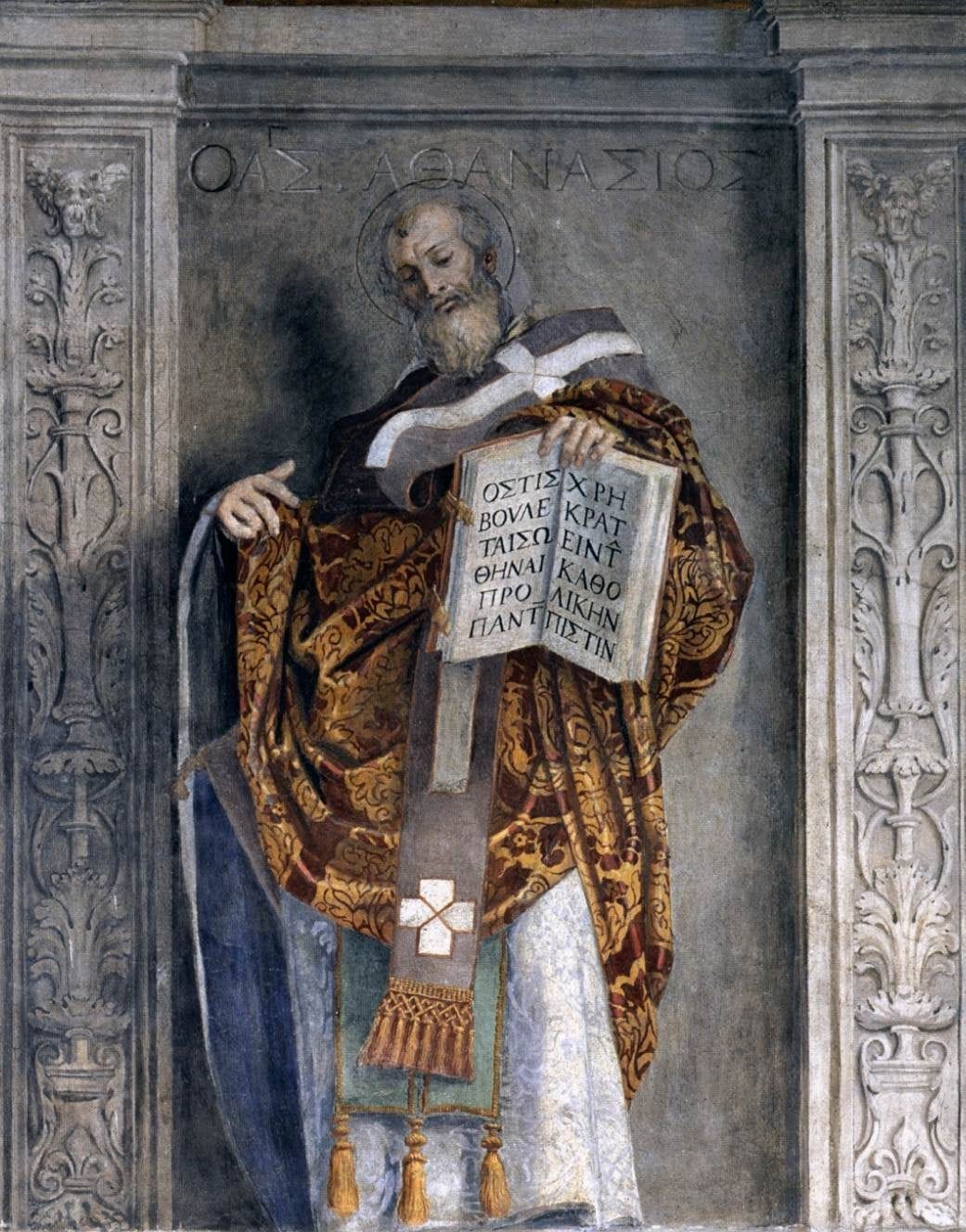
It’s important for us to distinguish between empty honorifics on the one hand, and metaphorical but truthful language on the other. While it’s true that St. Athanasius didn’t literally have episcopal “rule over the people,” as St. Gregory’s language suggests, we still have to ask the question: what truth is Gregory trying to communicate? It clearly can’t be the case that Gregory actually believes the complete and utter opposite of what he’s saying; something like, “there’s no sense at all in which Athanasius had charge over the whole world.” As noted above, when we encounter passages like this it’s important to look at the context, something many apologists fail to do.
Immediately before writing that St. Athanasius was “entrusted with the chief rule over the people,” the Theologian notes something curious: “Thus brought up and trained, as even now those should be who are to preside over the people, and take the direction of the mighty body of Christ, according to the will and foreknowledge of God, which lays long before the foundations of great deeds…” This is worth pausing on. In Gregory’s mind, there are many men “even now” being called to “preside over the people” and “take the direction” of the whole “body of Christ.” While Gregory likely has bishops in mind, his point isn’t that these men lead the Church by their jurisdictional authority, but rather by the “great deeds” that God has predestined them to carry out.
Just look at the scriptural verses that Gregory appropriates in order to describe how St. Athanasius was one of these great men: Athanasius was “left as a seed to Israel” (cf. Isa 1:9), he was “a horn of salvation [that] was raised up for us” (cf. Lk 1:69), he was “a chief cornerstone” (cf. Eph 2:20), a purifying fire (cf. Mal 3:2-3), and a winnowing-fork (cf. Matt 3:12). These aren’t biblical texts that describe ecclesiastical authority, but rather prophetic mission. The “chief rule” that Athanasius exercised over the people was less like the kings of Israel’s, and more like the ancient prophets.’ For the Theologian, St. Athanasius wasn’t an ecclesiastical ruler over the entire Church, rather he was a prophetic and spiritual ruler. Athanasius “ruled” the whole Church by the Holy Spirit empowering him with heroic virtue, not ecclesial authority. This is why, in the same work, Gregory says the following about Athanasius:
And therefore, first in the holy Synod of Nicæa, the gathering of the three hundred and eighteen chosen men, united by the Holy Ghost, as far as in him lay, he stayed the disease. Though not yet ranked among the Bishops, he held the first rank among the members of the Council, for preference was given to virtue just as much as to office.
St. Gregory the Theologian, Oration 21, 14.
Despite “not yet [being] ranked among the Bishops,” St. Gregory nonetheless holds St. Athanasius to have been “the first [in] rank among the members of the Council” of Nicaea. This simply underscores the point that, when we look at the context of this oration, it’s evident that Gregory is identifying Athanasius’ personal virtue as being the means by which he presided over the Church’s affairs during the Arian crisis. When Gregory uses language from Sacred Scripture to speak about Athanasius (which is different from interpreting Scripture to actually be about Athanasius), it likewise highlights his personal calling and sanctity as a virtuous man, and says absolutely nothing about any unique divine prerogatives being attached to his episcopal See.
To use an analogy, this would be akin to describing prophetic figures like St. Maximus the Confessor, St. Francis of Assisi, St. Catherine of Sienna, or St. Joan of Arc as the spiritual and prophetic “leaders” of the Church during their respective times. This isn’t an empty honorific, it’s true in a profound way. As Dan and Steven Alspach have documented at length in their study of prophetic gifts in the early Church,15 the Holy Spirit truly has an on-going mission of prophetic witness that He carries out through the saints. Sometimes those saints have an ecclesiastical rank, as in Athanasius’ case, other times they don’t. But as Gregory notes, “preference” ought to be “given to virtue just as much as to office” when it comes to the Lord’s chosen saints.
A similar line of reasoning can explain the other passage from this text that Sorin quotes: “[Athanasius] legislated again for the whole world, and brought all minds under his influence, by letters to some, by invitations to others, instructing some, who visited him uninvited, and proposing as the single law to all — Good will.”16 Once again, it’s obvious from the context that St. Gregory isn’t talking about literal ecclesiastical “legislation.” The Council of Nicaea had ecclesiastically “legislated” the doctrine of the Trinity, and yet that didn’t stop the Arian crisis. Something more than a conciliar decree was needed, and that’s what St. Gregory views St. Athanasius as having provided: “He cleansed the temple of those who made merchandise of God, and trafficked in the things of Christ, imitating Christ in this also; only it was with persuasive words, not with a twisted scourge that this was wrought.”17
It wasn’t Athanasius’ ecclesiastical authority that “brought all minds under his influence.” If the authority of 318 bishops at Nicaea wasn’t able to do that, then the authority of one more bishop certainly wouldn’t help. No, it was Athanasius’ “persuasive words” together with his show of “good will” that, in Gregory’s mind, “legislated” the Trinity in the hearts and minds of the whole world.
Circling back to Mr. Sorin’s claim that applying the Catholic “method of interpretation” to these texts leads to absurd conclusions, this is clearly not true. The method of interpretation with which I’ve approached all of his cited texts is to simply read them in context, and try to unpack what truth their authors were seeking to convey through their words. This is the exact same methodology I’ll apply to the papal claims later in this article. So far, we still haven’t seen a single example of a patristic writer claiming that someone other than the pope of Rome has inherited the divine commission that our Lord gave to St. Peter in Matthew 16, Luke 22, and John 21. Even all of the references to someone else being “the head” of the Church (which, if patristic references to the pope being “the head of the Church” were all Catholics had, then I would fully agree that the papacy is indefensible) have proven to mean something other than a quasi-papal claim when read in context.
If our Eastern Orthodox apologist’s argument was simply that Catholics need to be careful when interpreting patristic statements about the pope being “the head,” then his point would be well taken. But that’s not his argument. Instead, Sorin’s position seems to be that all ancient references to someone being “the head” of the Church are meaningless flattery, and so we don’t even have to bother understanding what different patristic authors actually meant by this language. All of the traditional arguments for the papacy can therefore be dismissed out of hand without any serious research! That would certainly make life easier for the inquirer into Eastern Orthodoxy and Catholicism, the only issue is that it’s not true.
St. Agatho’s Letter to the Sixth Ecumenical Council
The next quote that Sorin claims is nothing but an “empty honorific” is perhaps the most relevant one so far. It comes from the letter of Pope St. Agatho to the Sixth Ecumenical Council, a text that Catholics traditionally cite as providing evidence for the papal claims in the first millennium. Let’s take a look at what Sorin sees in this text as being nothing more than mere flattery:
For it was most pious and emanated from your [the Emperor’s] most meek tranquillity, taught by the divine benignity for the benefit of the Christian commonwealth divinely entrusted to your keeping, that your imperial power and clemency might have a care to enquire diligently concerning the things of God (through whom Kings do reign, who is himself King of Kings and Lord of Lords) and might seek after the truth of his spotless faith as it has been handed down by the Apostles and by the Apostolic Fathers, and be zealously affected to command that in all the churches the pure tradition be held. And that no one may be ignorant of this pious intention of yours, or suspect that we have been compelled by force, and have not freely consented to the carrying into effect of the imperial decrees touching the preaching of our evangelical faith which was addressed to our predecessor Donus, a pontiff of Apostolic memory, they have through our ministry been sent to and entirely approved by all nations and peoples; for these decrees the Holy Spirit by his grace dictated to the tongue of the imperial pen, out of the treasure of a pure heart…
The Letter of Pope Agatho. Translated by Henry Percival. From Nicene and Post-Nicene Fathers, Second Series, Vol. 14. Edited by Philip Schaff and Henry Wace. (Buffalo, NY: Christian Literature Publishing Co., 1900.) Revised and edited for New Advent by Kevin Knight. <http://www.newadvent.org/fathers/3813.htm>.
This is intriguing. St. Agatho says that the emperor was appointed by God to rule and that his imperial decrees that declared Jesus Christ is Lord (fully God and fully man, possessing both a divine will and a human will) were the work of the Holy Spirit! Surely this is just meaningless flattery, right? I honestly don’t think so.
Consider once again what the Apostle Paul wrote about the pagan Roman Empire: “there is no authority except from God, and those that exist have been instituted by God. Therefore whoever resists the authorities resists what God has appointed, and those who resist will incur judgment” (Rom 13:1-2). How much more could this be said of the Christianized Roman Empire to which St. Agatho wrote? Indeed, why couldn’t Agatho have literally believed in some form of “the divine right of kings”? He directly says that God is the one “through whom Kings do reign, who is himself King of Kings and Lord of Lords.” I see no reason to dismiss this as an empty honorific. As I wrote in a previous article that touched on this same topic, “Do we have any actual reasons to believe” that seventh century praise of the Roman Empire is mere flattery “other than imposing modern political views on ancient sources? Nope.”18
Likewise, recall what St. Paul wrote in 1 Corinthians 12:3, “no one can say, ‘Jesus is Lord,’ except by the Holy Spirit.” No one may confess that Jesus Christ our Lord is fully God and fully man without the Holy Spirit dictating this to his tongue. If it wasn’t meaningless flattery when St. Paul wrote it, then why must we believe that it was meaningless flattery when St. Agatho wrote it? In fairness to Mr. Sorin, I’ve seen actual scholars make arguments along similar lines. However, I’ve never seen anything more than a mere assertion that language like St. Agatho’s is meaningless. What reasons do we have to think so? Scholars like Fr. Klaus Schatz provide none. More will be said about this letter of Pope St. Agatho below.
The Papal Legates at Constantinople 879
The next quote that Sorin tries to argue is “empty honorifics” is, in my opinion, the worst one he could have possibly chosen. Sorin cites the following words from one of the papal legates who was present at the Council of Constantinople 879, the synod that restored Photius as the lawful patriarch of Constantinople:
I, Paul, unworthy bishop of the Holy Church of Ancona, legate of the Holy Apostolic See and of my master, Blessed John, the Supreme Pontiff of the Roman, Catholic and Apostolic Church and oecumenical Pope, accept, in accordance with my mandate, order and consent of the very Holy, Apostolic and Oecumenical Pope John, and with the assent of the Church of Constantinople and of the legates of the three other Patriarchs and with the approval of the same Holy and Oecumenical Synod, this venerable Photius, legitimate and canonically elected Patriarch, to his patriarchal dignity, and I am in communion with him in accordance with the tenor and the terms of the Commonitorium. I repudiate and anathematize the synod that was summoned against him in this Holy Church of Constantinople. Whatever, in whatever manner, was done against him at the time of Hadrian, of pious memory, then Roman Pope, I declare abrogated, anathematized and rejected in accordance with the Commonitorium, and that assembly I in no way reckon among the sacred synods. Whoever shall attempt to divide the Holy Church of God and sever himself from his own supreme pastor and oecumenical Patriarch, the saintly Photius, must himself be severed from the Holy Church of God, and until he returns to her, communicates with the Holy and oecumenical Patriarch and submits to the judgement of the Holy See, must remain excommunicated. Moreover, to the holy and oecumenical synod which met for the second time in Nicaea on the subject of the sacred and venerable images, at the time of Hadrian I, Roman Pope of blessed memory, and of Tarasius, the very holy Patriarch of the Church of Constantinople, I give the name of Seventh Council and number it with the six holy synods. Signed with my own hand.
Fr. Francis Dvornik, The Photian Schism: History and Legend, pp. 193-4.
Now, Mr. Sorin didn’t quote this entire text, he just cited the papal legate’s statement that Photius is the easterners’ “own supreme pastor and oecumenical Patriarch,” and his conclusion was that “Photius is the pope” according to these words. Yet this is clearly false. Bishop Paul begins his statement by referring to “Blessed John, the Supreme Pontiff of the Roman, Catholic and Apostolic Church and oecumenical Pope… the very Holy, Apostolic and Oecumenical Pope.” According to Paul, Pope John VIII is the “oecumenical” or “universal” pope, while Photius is simply the easterners’ “own supreme pastor and oecumenical Patriarch.”
This same sentiment was echoed by “John the most God-beloved metropolitan of Heraclea” who said:
By his [Pope John VIII’s] holy prayers we have already become one flock, and we have one true shepherd, holy and guileless, Photius our most holy master and oecumenical patriarch.
The Acts of the Eighth Œcumenical Council, trans. Gregory Heers, p. 186.
In context, Photius is the “one true shepherd” of the Church of Constantinople. This is why John of Heraclea, an eastern bishop, refers to Photius as “our most holy master and oecumenical patriarch.” This language was no mere flattery. The eastern bishops at Constantinople 879 were absolutely serious that Photius was their one lawful patriarch, and thus the one lawful head of all of the Eastern Churches. This was likely directed against the party in Constantinople led by Metrophanes of Smyrna that refused to recognize Photius as their patriarch.
Once again, in context, none of this was to the detriment of the Roman pontiff’s supreme and divine headship over the entire Church. Just look at the letter of Pope John VIII, which was brought to the Council of Constantinople 879 by the same papal legates whom Sorin claims engaged in nothing but mere flattery:
Ye laid hold of the holy church of the Romans through your apocrisiaries and your most godly letters, being convinced that she would not neglect to help you toward your purpose. Ye were not the first to arrive at this thought, but ye were rather giving way and closely following after the custom of those that had piously reigned before you. But really, it deserves to be asked, from which teacher were ye taught to do this? Was it not clearly from the chief of the apostles Peter, whom the Lord appointed head of all the churches, saying, “Feed my sheep”? Yet not only from him, but also from the holy Councils and ordinances, and also from the institutions and teachings of the sacred and orthodox and venerable fathers, as your godly and pious letters also testify.
Letter of Pope John VIII to Emperor Basil the Macedonian, The Acts of the Eighth Œcumenical Council, trans. Gregory Heers, p. 200.
While Mr. Sorin may wish to dismiss this letter as “mere flattery,” that’s not how the very scholar on whom he relies, Fr. Francis Dvornik, interpreted it:
In his letter to Basil, the Pope begins by expressing satisfaction that Basil should submit to the authority of the Roman See, an authority confirmed by the Founder of that See [Christ] when He said to St Peter, “Feed my sheep.” He also notes with pleasure that Basil acknowledged this See to be the head of the whole Church. In deference to the Emperor’s wishes, although Photius had resumed his see without Rome’s consent, the Pope is agreeable to his being the legitimate Patriarch; but Photius should apologize before the synod and make amends for his previous conduct. In the exercise of his powers to bind and loose, the Pope releases Photius and his bishops from the ecclesiastical censures imposed on them. It is the Roman See’s right to judge Patriarchs; and as the condition of his recognition by Rome, Photius must no longer exercise any ecclesiastical powers in Bulgaria. The Emperor must honour Photius and give no ear to his detractors. Basil must also receive all the Ignatian bishops returning to Photius, and those who refuse to accept the new state of things are threatened with excommunication.
Fr. Francis Dvornik, The Photian Schism: History and Legend, p. 174.
According to Fr. Dvornik, this papal letter is no empty honorific. John VIII, as the successor to St. Nicholas I (!) and Hadrian II, followed his predecessors’ belief that Christ not only made the Roman See “the head of the whole Church” through his commission to St. Peter in John 21, but also that our Lord gave Rome the “authority” and “right” to “judge Patriarchs” through her Petrine succession. In Dvornik’s words, John VIII held it to be “in virtue of the authority vested in the successor of St Peter” that he “approve[d] his [Photius’] nomination to the patriarchate.”19 Since John VIII made these papal claims in the context of literally enacting his own perceived divine power of judgment over Photius and the See of Constantinople, reading his words as mere flattery isn’t a serious position to hold.
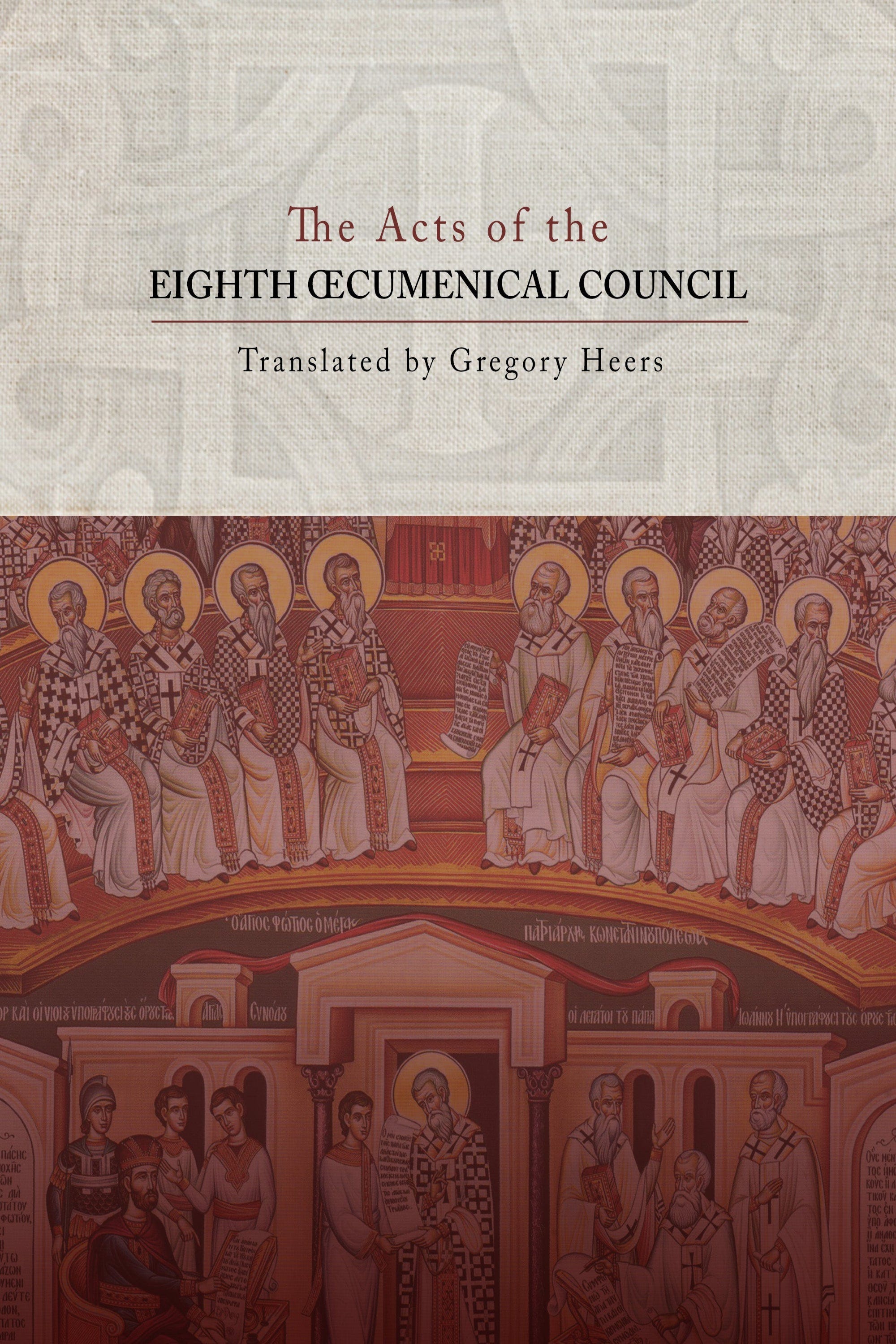
Nor am I alone in this perspective. Fr. Peter Heers, a well known Eastern Orthodox polemicist and a staunch critic of Catholicism, put out a translation of The Acts of the Eighth Œcumenical Council through his publication, Uncut Mountain Press. Here’s what that volume has to say about the above quoted letter from Pope John (the actual commentary was written by Dr. Constantine Siamakis):
Boundless arrogance on the part of the pope of Rome. He places first the pope, himself, identifying him with Christ and Peter; below him are the Oecumenical Councils; below the councils are every single one of the Fathers of the Church. Holy Scripture and sacred tradition are substituted by the pope, as expressed by the pope himself and in fact at a time when he needs to flatter Basil most servilely because of the Arab danger.
The Acts of the Eighth Œcumenical Council, trans. Gregory Heers, p. 200n186.
For both Dvornik and Siamakis, Pope John VIII—and by extension his legates—wasn’t at all ambiguous in what he claimed at the Council of Constantinople 879. The pope and his legates all believed that, by the institution of Jesus Christ Himself, the See of Rome was the head and judge of all other Churches. This is a claim that became intolerable to the East only after the Great Schism, as Siamakis inadvertently attests.
Indeed, in his commentary on Constantinople 879, the Eastern Orthodox polemicist Craig Truglia writes that the eastern bishops there “fail[ed] to censure the Papal legates on this point,” i.e. the pope’s divine headship over the Church. “From an Orthodox perspective,” Truglia continues, “This would be the council’s chief failure.”20 The 17th century Eastern Orthodox patriarch of Jerusalem, Dositheus II, likened the claims made in John VIII’s letter to those made by “Agatho’s [epistle] in the Sixth” Ecumenical Council and “Hadrian’s in the Seventh.” For Dositheus, John VIII’s teachings were “irrational,” especially “the pope’s excessive and uncanonical words concerning the Roman church.”21 So to turn Sorin’s rhetoric against him: “these are your sources, these are your scholars” saying that the papal legates at Constantinople 879 weren’t engaged in empty flattery.
Something I found quite amusing about reading Siamakis’ and Dositheus’ take on John VIII’s papal claims is that, while they loudly complained about these claims contradicting a “truly orthodox” view of the pope, the eastern bishops who were actually present at Constantinople 879 did no such thing. In fact, when the papal legates arrived at the council, here’s what went down (as Siamakis himself records):
“[T]he most pious Peter, inasmuch as he is even now with us, brings with him honorable epistles from the most holy Pope John.”
The most holy Patriarch Photius said, “Thanks be to our good God, who preserved him and restored him unto us in peace and health. Let them enter.”
When they had entered, Photius the most holy patriarch said, “Glory to our God, to the Consubstantial and Life-giving Trinity, always, now and ever and unto the ages of ages.”
The holy Council rejoined, “Amen,” and when the prayer had been done according to the custom, Photius, our most holy master and œcumenical patriarch, embraced and kissed Peter the most God-fearing presbyter and those with him, adding, “God brought you here well. May the Lord accept your labour; may He bless and hallow your souls and bodies; and may He also accept the care and concern of our most holy brother and concelebrant and spiritual father, the most blessed Pope John.”
[24] Peter, the most pious presbyter, cardinal and representative of the most holy Pope John, stated, “Blessed be God, for we have found your holiness in good health; Saint Peter is visiting you.”
Photius the most holy patriarch said, “May Christ our God, through Peter the chief of the Apostles, whom your piety has commemorated, have mercy on us all and prove us worthy of His Kingdom.” Peter the most pious presbyter and cardinal said, “The most holy and œcumenical Pope John bows down before your holiness.” Photius the most holy patriarch replied, “We in turn bow down before him with cordial yearning; and we beseech God that his holy prayers and precious love be granted unto us.”
The Acts of the Eighth Œcumenical Council, trans. Gregory Heers, p. 183.
For the eastern bishops at the 879 council, including Photius himself, Pope John VIII was their “spiritual father.” When the papal legate told Photius that, through the letters of Pope John, “Saint Peter is visiting you,” Photius received this with joy: “May Christ our God, through Peter the chief of the Apostles, whom your piety has commemorated, have mercy on us all and prove us worthy of His Kingdom.” Unlike Siamakis, Photius didn’t rebuke John VIII for “identifying him[self] with Christ and Peter.”22 While Dositheus II of Jerusalem dared to say that “sin lies with the author” of these papal claims,23 Photius called the author of these claims “our most holy brother and concelebrant and spiritual father, the most blessed Pope John.”24
The Truth About the Papal Claims
Recall Sorin’s original argument: “for almost every quote [in the early Church] exalting Rome, there’s a corresponding quote to other major Sees.” This isn’t a claim that’s original to Sorin; it’s used quite frequently by anti-Catholic polemicists seeking to “disprove” the papacy. However, as I’ve documented throughout this article, not a single quote Sorin provides says anything about another See (1) uniquely inheriting the ministry of apostolic headship that our Lord entrusted to St. Peter in Matthew 16, Luke 22, and John 21, or (2) possessing this headship until the end of time. These are the two points that, as I will argue below, constitute the essence of the papal claims in the first millennium. Indeed, these are the points I was expecting Sorin to prove were predicated of “everyone and anyone” in the first millennium. Yet he couldn’t provide even one example of these claims being made of any See except for Rome. It’s thus to these Roman claims that I will now turn my attention.
Constantinople 879
Throughout this article, my “method of interpretation” has been simple. I’ve tried to read all of the passages under dispute in context, and understand what truth their authors were trying to convey. It’s with this same methodology that I’ll approach the papal claims of the first millennium. Since Sorin himself brought up the Council of Constantinople 879, and since I’ve already touched on it above, I’ll start by analyzing the papal claims made at this council, and work backwards from there.
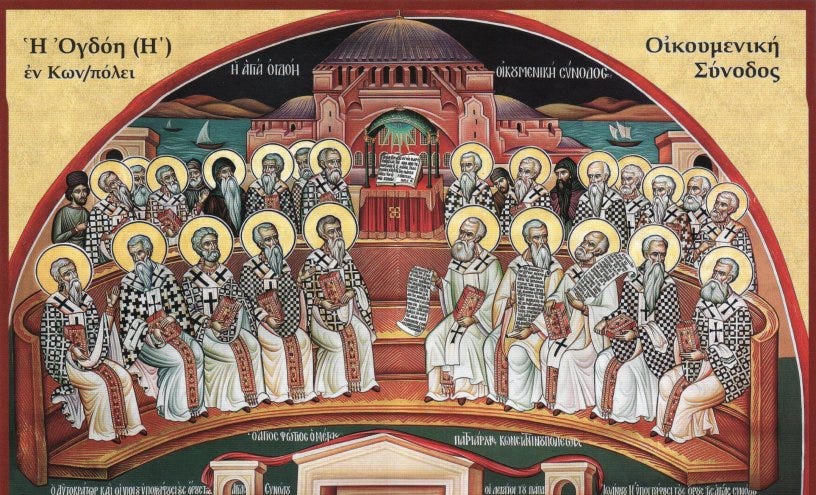
In his letters to the council, and in addition to what’s already been quoted above, Pope John VIII wrote even more about his own papal office. But before diving into that, let’s first consider the historical context of his letters. Just over a decade prior, one of John VIII’s predecessors, Pope St. Nicholas I, had inserted himself into the controversy surrounding the deposition of the then patriarch of Constantinople, St. Ignatius. Believing himself to be “entitled to the last word in disputes over ecclesiastical matters as much in the East as in the West,”25 St. Nicholas wrote the following to Emperor Michael III about why Constantinople should have never dared to cause such a controversy without involving Rome:
If you have not heard us, it remains for you to be with us out of necessity, such as our Lord Jesus Christ has commanded those to be considered, who disdained to hear the Church of God, especially since the privileges of the Roman Church, built on Blessed Peter by the word of Christ, deposited in the Church herself, observed in ancient times and celebrated by the sacred and universal Synods, and venerated jointly by the entire Church, can by no means [be] infringed upon, by no means changed; for the foundation which God has established, no human effort has the power to destroy, and what God has determined, remains firm and strong…
Thus the privileges granted to this holy Church by Christ, not given by the Synod, but now only cele brated and venerated… Since, according to the canons, where there is a greater authority, the judgment of the inferiors must be brought to it to be annulled, or to be substantiated, certainly it is evident that the judgment of the Apostolic See, of whose authority there is none greater, is to be refused by no one. If indeed they wish the canon to be appealed to any part of the world; from it, however, no one may be permitted to appeal... We do not deny that the opinion of this See can be changed for the better, when either something shall have been stealthily snatched from it, or by the very consideration of age or time, or by a dispensation of grave necessity, it shall have decided to regulate something. We beseech you, however, never question the judgment of the Church of God; that indeed bears no prejudgment on your power, since it begs eternal divinity for its own stability, and it beseeches in constant prayer for your well being and eternal salvation.
St. Nicholas I, from epistle (8) “Proposueramus quidem” to Michael the Emperor, 865, in The Sources of Catholic Dogma, eds. Denzinger and Rahner, 133.
Pope St. Nicholas, a predecessor of Pope John VIII, isn’t ambiguous in the slightest. He expressly states that the power he has to exercise universal and immediate jurisdiction over the East was “granted to this holy Church [of Rome] by Christ, not given by the Synod.” The privileges of Rome were “built on Blessed Peter by the word of Christ,” and this “foundation which God has established, no human effort has the power to destroy.” It’s because of these divine prerogatives that “the judgment of the Apostolic See, of whose authority there is none greater, is to be refused by no one.” Remember the context: Nicholas is claiming this as the basis upon which he’s inserting himself into the ecclesiastical affairs of the East! This is no time for empty honorifics. Pope Nicholas meant business, and not a serious scholar out there doubts this.
With this background in mind, it’s obvious that John VIII was aware of the papal claims of his predecessor. If he wished to condemn them, as the Eastern Orthodox do today, he certainly could have. Yet he chose not to. Instead, when it was most conducive to the peace of the Church to restore Photius to the See of Constantinople, Pope John wanted to make sure that everyone was aware that this was happening by the very papal authority that St. Nicholas had used to initially get Photius deposed:
Not only to these deposed ones, though they were of such sort and some of them came from heresy, did this apostolic see [Rome] extend a helping hand, but also to orthodox hierarchs and patriarchs who had taken refuge in her, just as the most pious Photius even now, and she came to the aid of them that were calling upon her succor. Ye all know the great Athanasius, bishop of Alexandria, Cyril and Polychronius of Jerusalem, John, whom your love calls the Goldenmouth, and Flavian of Constantinople; for when these had been deposed and renounced by councils and had run under the lee of the holy church of the Romans, this apostolic throne recommended and restored them to their former honour. If, therefore, those that got their ordination from the Donatists and those that got it from Bonosus, having been driven out of the courtyard of the orthodox Church by a multitudinous council, are once more received by another council and are enrolled among the priests, so that the Church of God may remain unsundered, pure and free of schisms (for there is nought so abominable and hateful to behold in the eyes of God as the swarm of schisms arising in the Church of God, and nought more delightful or more beloved to His goodness as a Church preserving Her wholeness in love for God and in onemindedness with neighbour), much more must men eminent in the orthodox Faith, renowned for holiness of life and exactitude of conversation, and almost not even so far as to commit works [worthy] of penance, not be despised as being responsible, weighed down by the yoke of penance, but rather they are to be gladly accepted in accordance with their former honour. [17] For this apostolic throne, having received once for all the keys of the kingdom of the heavens from the first and great high priest Jesus Christ through the chief of the apostles Peter, to whom the Lord said, “I will give unto thee the keys of the kingdom of heaven,” and “whomsoever thou shalt bind on earth shall be bound in heaven: and whomsoever thou shalt loose on earth shall be loosed in heaven,” has complete authority both to bind and to loose and, according to the prophet Jeremiah, to root out and to plant.
Wherefore we also, employing the authority of the chief of the apostles Peter, together with the entirety of our most holy church, do exhort you, and through you also our most holy brethren and concelebrant patriarchs, of Alexandria, of Antioch, of Jerusalem, and the other hierarchs and priests and the whole fullness of the church of the Constantinopolitans, to agree and become of one mind with us, or rather with God, in all matters about which ye inquired; and first, to accept Photius the most admirable and pious hierarch of God and patriarch, our brother and concelebrant, sharer and partaker and heir of communion with the holy church of the Romans.
The Acts of the Eighth Œcumenical Council, trans. Gregory Heers, p. 204-5.
Pope John begins by giving the Greeks a history lesson. He recounts several episodes in Church history when previous “orthodox hierarchs and patriarchs” who had been “deposed and renounced by councils” took “refuge” in the Church of Rome. Whether it was Ss. Athanasius, Cyril, or John Chrysostom, “this apostolic throne [Rome] recommended and restored them to their former honour.” Why, in John VIII’s mind, could Rome do such a thing as overturn any judgment of any council in the world? He gladly explains. It’s because “this apostolic throne,” i.e. Rome, “having received once for all the keys of the kingdom of the heavens from the first and great high priest Jesus Christ through the chief of the apostles Peter, to whom the Lord said, ‘I will give unto thee the keys of the kingdom of heaven…’ has complete authority both to bind and to loose and, according to the prophet Jeremiah, to root out and to plant.” It’s with this very “authority of the chief of the apostles Peter” that Pope John ultimately declares Photius to be the lawful patriarch of Constantinople.
John VIII’s legates would even go on to reinforce their master’s papal claims by stating that the successor of St. Peter is the one through whom all pastors, including Photius, derive their authority:
Procopius, the most God-beloved archbishop of Caesarea in Cappadocia said, “He [Metrophanes of Smyrna] oftentimes excuses himself with illness and oftentimes with feebleness, and employs all craft to avoid judgement before your holiness.”
The most holy representatives of the elder Rome said, “We have given our opinion regarding him just as our most holy and œcumenical pope ordered. For let your holiness remember that we read before you the epistle of the most holy Pope John, and in it he wrote concerning the peace of the Church and the acceptance of those who come in sincere repentance, and that shepherds can loose all that is bound.”
Procopius the most God-beloved archbishop of Caesarea in Cappadocia said, “If they do not loose what is bound, what else can they do?”
Peter the most God-fearing presbyter and cardinal said, “The œcumenical and apostolic Pope John, having received this authority from Peter the chief of the apostles, has given also to the most holy Patriarch Photius the ability to bind and loose through this authority. But by these excuses of his, Metrophanes wishes to avoid the condemnation that hangs over him, yet he will not be able to escape it. For with the authority given him by the most holy Pope John, even without our presence the most holy Patriarch Photius will apply the punishment appropriate to him.”
Photius the most holy patriarch said, “What do ye think about those who from the hierarchal order enroll themselves into the station of monks? Giving themselves over to submission, can they still retain their hold on shepherdship?”
The most holy representatives said, “Among us, this thing neither exists nor is preserved. For whoever from the hierarchal order is enlisted into the station of monks, that is, of those repenting, can no longer claim for himself the dignity of high priesthood.”
The Acts of the Eighth Œcumenical Council, trans. Gregory Heers, pp. 304-5.
According to the papal legates, not only is Pope John “loosing” the sentence that his predecessor had “bound” against Photius, but he’s also giving Photius the episcopal power to bind and loose in virtue of his Petrine authority: “Pope John, having received this authority from Peter the chief of the apostles, has given also to the most holy Patriarch Photius the ability to bind and loose through this authority.” The footnote in Heers’ translation summarizes this well:
According to the cardinal, it is the pope of Rome that gives the patriarch of Constantinople the episcopal authority to bind and loose.
The Acts of the Eighth Œcumenical Council, trans. Gregory Heers, pp. 304n324.
For John VIII and his legates, the pope of Rome has received the power of binding and loosing directly from St. Peter (cf. Matt 16:18-19), and all other bishops, including patriarchs like Photius, receive this same authority from or through the pope. Any informed reader should be able to see the “ultramontanist” implications this has. If the successor of St. Peter is the source of all episcopal jurisdiction in the Church, as this language demands, then the Catholic teaching on the pope’s jurisdictional authority over the Church seems to follow. Indeed, centuries later, St. Francis de Sales would take this very “papal logic” and argue the following against the Reformers:
But I say that it is not all one to promise the keys of the kingdom [Matt 16:19] and to say, Whatever thou shalt loose [Matt 18:18], although one is an explanation of the other. And what is the difference? Certainly just that which there is between the possession of an authority and the exercise of it. It may well happen that while a king lives, his queen, or his son, may have just as much power as the king himself to chastise, absolve, make gifts, grant favors. Such person, however, will not have the scepter but only the exercise of it. He will indeed have the same authority, but not in possession, only in use and exercise. What he does will be valid, but he will not be head or king, he must recognize that his power is extraordinary, by commission and delegation, whereas the power of the king, which may be no greater, is ordinary and is his own.
So Our Lord promising the keys to S. Peter remits to him the ordinary authority and gives him that office in ownership, the exercise of which he referred to when he said, Whatsoever thou shalt loose, and so on. Now afterward, when he makes the same promise to the other Apostles, he does not give them the keys or the ordinary authority, but only gives them the use and exercise thereof. This difference is taken from the very terms of the Scripture, for to loose and to bind signifies but the action and exercise, to have the keys, the habit… See how different is the promise which Our Lord made to S. Peter from that which he made to the other Apostles. The Apostles all have the same power as S. Peter, but not in the same rank, inasmuch as they have it as delegates and agents, but S. Peter as ordinary head and permanent officer.
And in truth it was fitting that the Apostles who were to plant the Church everywhere, should all have full power and entire authority as to the use of the keys and the exercise of their powers, while it was most necessary that one among them should have charge of the keys by office and dignity, “that the Church, which is one,” as S. Cyprian says, “should by the word of the Lord be founded upon one who received the keys thereof.”
St. Francis de Sales, The Catholic Controversy, Part II, Article VI, Chapter III.
Can one truly say that John VIII would have disagreed with St. Francis’ interpretation of Matthew 16:19 and 18:18? For both men, it was Peter alone who received the keys of the kingdom, and this unique authority allows Peter’s successor, the pope, to delegate the keys’ power of binding and loosing to the other successors of the apostles. This is the very “papal logic” that would be taken up by the fathers of Vatican I when articulating their teaching on the pope’s supreme jurisdiction. Also take special note of the fact that, after Pope John’s legates stated these papal beliefs with extraordinary clarity, Photius and the eastern bishops at Constantinople 879 said absolutely nothing to contradict them. More will be said on this below.
Pope John VIII’s “ultra-papalism” is thus no different from that of Pope St. Nicholas. For both pontiffs, it was the divine promise that our Lord made to St. Peter in texts such as Matthew 16:18-19 that invested Rome with “complete authority both to bind and to loose,” “to root out and to plant.” And once again, this was no time for empty honorifics. Like Nicholas, John took the papal claims seriously. We know this because he cited them as the source of his “authority” to “loose” the sentence against Photius which his predecessor had “bound.” Even Nicholas had affirmed, “We do not deny that the opinion of this See [Rome] can be changed for the better,” it just has to be done by “the judgment of the Apostolic See” herself, “of whose authority there is none greater.”26 John was simply putting this into practice, thereby affirming the papal claims of Nicholas to de jure divino immediate and universal jurisdiction.
Fr. Francis Dvornik, the scholar whom Sorin has accepted as a reliable interpreter of Constantinople 879, says the following about John VIII’s papal claims:
These words are clear. The fact that this passage of the Latin text was retained in the Greek version and in fact underlined by the addition of the words of Jeremiah (Jer. I. 10) is very revealing of the attitude maintained by Photius and his Chancery with regard to the Roman Primacy. This famous passage of Jeremiah had been applied, in 866, by Nicholas I to the Emperor Michael: “Behold, today I give thee authority over the nations and over the kingdoms, to root them up and pull them down, to overthrow and lay them in ruins, to build them up and plant them anew.” It is more than merely probable that Photius and his Chancery knew this letter and the passage in question had not escaped their attention. This gives a par ticular interest to the addition of the passage in the Greek version of the letter of John VIII and to its application to the Pope. It is extremely regrettable that this source has been, up to the present time, completely forgotten by historians and modern theologians. But it was one of the great canonists of the Middle Ages, Ivo of Chartres, who recognized its importance and inserted it in his canonical collection. He and the other medieval canonists made use of it as an important argument to prove that the Pope, by reason of the plenitude of power which he possessed, had the power to annul any sentence whatever.
Fr. Francis Dvornik, Byzantium and the Roman Primacy, p. 112.
Not only does Dvornik affirm that John VIII was of one mind with St. Nicholas on the papacy (i.e. there’s no empty honorifics here), but he even notes something remarkable. Photius himself recognized the continuity between the papal claims of Pope John and Pope Nicholas. We know this because (for unknown reasons) Photius and his Chancery reinforced John’s papal authority by expanding the Greek version of his letter, adding the application of Jeremiah’s language of “uprooting” and “planting” to Rome. What makes this especially ironic is that, in Heers’ translation of that very passage—“[Rome has] complete authority both to bind and to loose and, according to the prophet Jeremiah, to root out and to plant”—we find the following footnote:
Arrogant boasting on the part of the pope of Rome.
The Acts of the Eighth Œcumenical Council, trans. Gregory Heers, p. 204n202.
Unfortunately for Siamakis, it turns out that “Photius and his Chancery” were actually responsible for this particular “arrogant boasting,” not John VIII. For Dvornik, their adding Jeremiah 1:10 to Pope John’s citation of Matthew 16:19 is “very revealing of the attitude maintained by Photius and his Chancery with regard to the Roman Primacy.” In other words, according to the very scholar cited by Sorin in his debate, even Photius himself ended up signing off on the papal claims as substantive, not meaningless flattery.
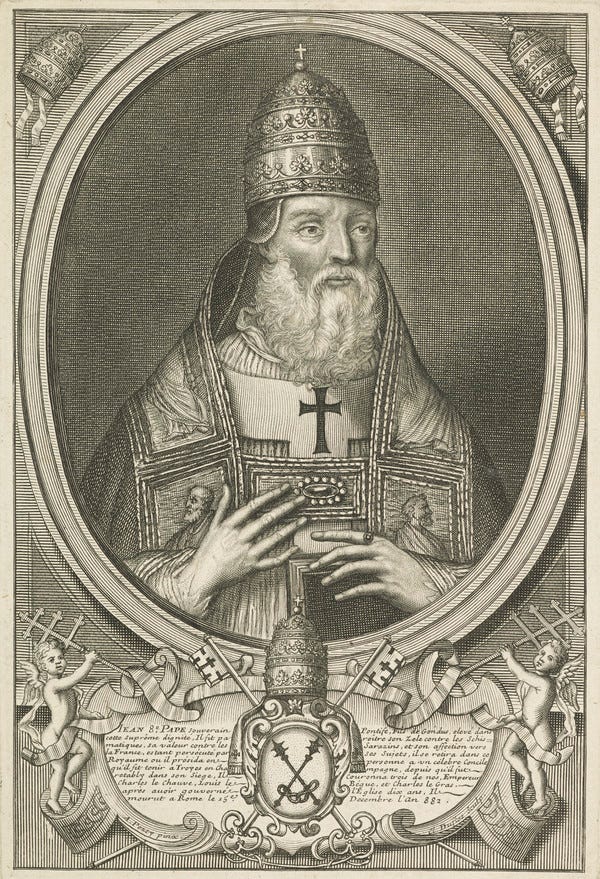
Indeed, this sheds light on why one has to wait until after the Great Schism in order to see explicit condemnations of John VIII’s teachings from the East. As shown above, Siamakis was joined by Dositheus II of Jerusalem (d. 1707) in taking issue with the papal claims that weren’t condemned by Photius and Constantinople 879. Dositheus’ rationalization was that the council fathers explicitly rejected Pope John’s papalism:
After the pope’s [John VIII’s] epistles were read and the representatives of the bishop of Rome had asked the Council if they accepted them, the latter replied that they accept as many [parts of the epistles] as are contained in right and lawful speech, and not simply that they accept them, as had happened at the other Ecumenical Councils. Yet it must be said, first, that at the Council in Chalcedon Leo’s epistle is heavily scrutinized, as is Agatho’s in the Sixth and Hadrian’s in the Seventh. See those places and note especially that at that time also, the fathers discerningly accepted the things that had to do with the issues which the Councils were facing, but they did not also accept everything that the popes or others said about themselves…
Therefore, the epistles were accepted for what they said concerning those matters for which the Council had been convened, which were right and lawful; the Council, however, did not accept the irrational things, the demand that they leave Bulgaria to the bishop of Rome and the pope’s excessive and uncanonical words concerning the Roman church. In fact, they expressly rejected them, and the sin lies with the author and not with them that did not accept.
Dositheus II of Jerusalem, qtd. in The Acts of the Eighth Œcumenical Council, trans. Gregory Heers, pp. 376-7.
Dositheus thus makes an argument that nobody prior the Great Schism felt the need to; and it’s wrong. It’s manifestly not the case that Photius and the council of 879 “expressly rejected” the papal teachings of John VIII.
As shown above, Photius and his Chancery weren’t afraid to edit the Greek versions of Pope John’s letters. In fact, Dvornik documents how “the Patriarchal Chancery” made “fairly numerous” alterations to John’s letters.27 They “paraphrased the introduction” of his letter to Emperor Basil, “which was too severe.” They also “considerably improved upon the Pope’s compliments paid to the wisdom of the Emperor and of his sons.” They removed all praise of St. Ignatius and the previous council of 869. However, “what is curious” according to Dvornik “is that the Pope’s emphasis on the primacy of his See has scarcely been touched.” Indeed, “the Greek version, for all its doctoring, has preserved some expressions endorsing the Roman thesis of the primacy, which John VIII appealed to in the original.”
Photius was perfectly fine voicing his disagreements with Rome, and even manipulating conciliar documents to do so. Yet despite that, he chose to leave the essence of John VIII’s (and, by extension, Nicholas I’s) papal claims untouched. Those claims being that (1) the pope of Rome has inherited the supreme authority over the Church that our Lord gave to St. Peter, and (2) that “no human effort has the power to destroy” this Roman primacy.28 At one point, Photius even strengthened these claims by adding an additional biblical basis for them. What is one to conclude from this other than that Photius and the council of 879 didn’t “expressly reject” papal supremacy as it was laid out by Pope John and his legates? What is one to conclude other than that Dositheus’ assessment of the council, which is (in my opinion) the only assessment that could possibly save Eastern Orthodoxy, is wrong?
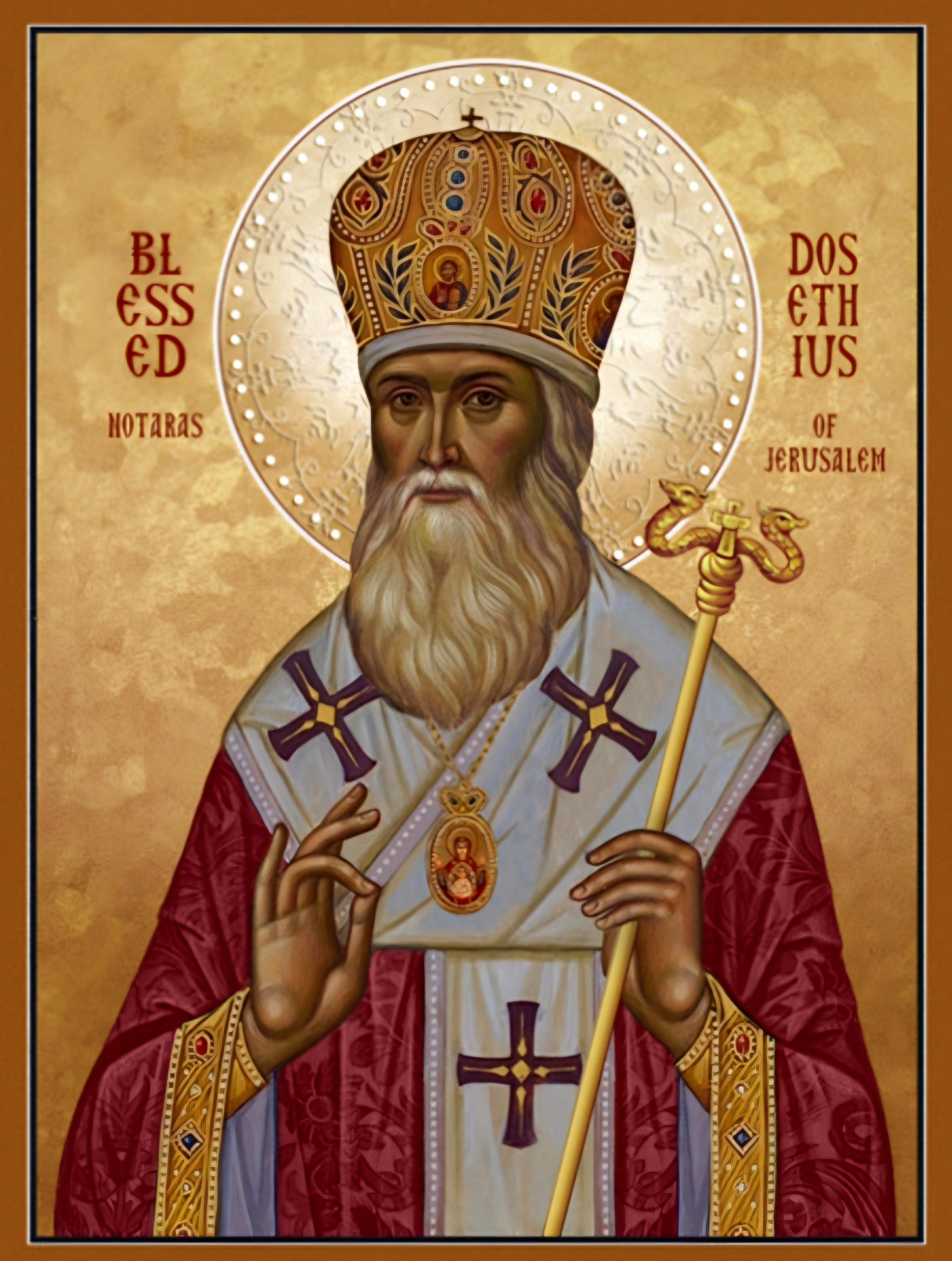
As a final remark on this subject, here’s what I find deeply fascinating about Dositheus’ gloss on the events of Constantinople 879: he clearly sees the connection between the papal claims of John VIII and those made in the letters of St. Agatho to the Sixth Ecumenical Council, and Hadrian I to the Seventh Ecumenical Council. Dositheus seems to denounce them all as “excessive and uncanonical words concerning the Roman church.”29 He even says that “sin lies with the author” of the claims made by John VIII, which would consequently extend to Agatho and Hadrian as well. Unlike modern Eastern Orthodox apologists (such as Alex Sorin), Dositheus didn’t believe that these sources contained “meaningless flattery” or “empty honorifics.” The first millennium popes meant what they said, and as Dositheus inadvertently attests, the East knew this but chose to remain silent.
Hadrian’s Letter to Nicaea II
That makes for a perfect segue into the next prominent example of the papal claims I’d like to discuss: the letter of Pope Hadrian to the Seventh Ecumenical Council. As noted, Dositheus so strongly disagreed with the content of this letter that he grouped it in a series of papal letters that could not possibly have been accepted by an Ecumenical Council. Let’s see why a post-schism Eastern Orthodox patriarch would so strongly oppose a letter that was, in fact, accepted by an Ecumenical Council.
In his letter to Emperor Constantine VI, which was read out loud at Nicaea II, Pope Hadrian I taught the following:
If you persevere in that orthodox Faith in which you have begun, and the sacred and venerable images be by your means erected again in those parts, as by the lord, the Emperor Constantine of pious memory, and the blessed Helen, who promulgated the orthodox Faith, and exalted the holy Catholic and Apostolic Roman Church your spiritual mother, and with the other orthodox Emperors venerated it as the head of all Churches, so will your Clemency, that is protected of God, receive the name of another Constantine, and another Helen, through whom at the beginning the holy Catholic and Apostolic Church derived strength, and like whom your own imperial fame is spread abroad by triumphs, so as to be brilliant and deeply fixed in the whole world. But the more, if following the traditions of the orthodox Faith, you embrace the judgment of the Church of blessed Peter, chief of the Apostles, and, as of old your predecessors the holy Emperors acted, so you, too, venerating it with honour, love with all your heart his Vicar, and if your sacred majesty follow by preference their orthodox Faith, according to our holy Roman Church. May the chief of the Apostles himself, to whom the power was given by our Lord God to bind and remit sins in heaven and earth, be often your protector, and trample all barbarous nations under your feet, and everywhere make you conquerors. For let sacred authority lay open the marks of his dignity, and how great veneration ought to be shown to his, the highest See, by all the faithful in the world. For the Lord set him who bears the keys of the kingdom of heaven as chief over all, and by Him is he honoured with this privilege, by which the keys of the kingdom of heaven are entrusted to him. He, therefore, that was preferred with so exalted an honour was thought worthy to confess that Faith on which the Church of Christ is founded. A blessed reward followed that blessed confession, by the preaching of which the holy universal Church was illumined, and from it the other Churches of God have derived the proofs of Faith. For the blessed Peter himself, the chief of the Apostles, who first sat in the Apostolic See, left the chiefship of his Apostolate, and pastoral care, to his successors, who are to sit in his most holy seat forever. And that power of authority, which he [Peter] received from the Lord God our Saviour, he too bestowed and delivered by divine command to the Pontiffs, his successors.
Translated by Henry Percival. From Nicene and Post-Nicene Fathers, Second Series, Vol. 14. Edited by Philip Schaff and Henry Wace. (Buffalo, NY: Christian Literature Publishing Co., 1900.) Revised and edited for New Advent by Kevin Knight. <http://www.newadvent.org/fathers/3819.htm>.
Notice how this claim to divine headship over the Church is different from all of the alleged examples of “empty honorifics” cited by Sorin. Recall that, in the case of St. Meletius of Antioch, St. Basil wrote that he was the head over certain Churches in the East, since he was the patriarch of Antioch, one of the primatial eastern Sees. Moreover, in his letters that we examined, Basil doesn’t actually give any explanation for why the See of Antioch holds its rank among the Churches of the East; that’s just not a subject about which he felt the need to comment.
Similarly, remember how Ss. Basil and Gregory considered St. Athanasius to be the moral or spiritual head over the Church, not because of any unique authority that he inherited from his episcopal See, but because of the heroic virtue with which God invested him. Once again, there was nothing even close to a claim that Athanasius inherited an immovable divine prerogative through the See of Alexandria.
All of this is radically different from what Pope Hadrian claims about Rome. First, let’s consider the context of his letter. Unlike St. Basil, an eastern bishop who wrote to another eastern bishop about an eastern affair, Hadrian, the patriarch of the West, is writing to an entire council of eastern bishops gathered with their eastern emperor. Any talk of “headship” in this context clearly extends beyond Hadrian’s headship over the Western Church. Indeed, if you’re one of the most powerful men in the Christian West, you wouldn’t write to the most powerful man in the Christian East, the Byzantine emperor, that your See is his “spiritual mother” and “the head of all Churches” unless you meant what you said.
Second, unlike Sorin’s “empty honorifics” examples, Hadrian actually provides an explanation for why his See stands at the helm of the Church. It’s because (1) “the Lord set him who bears the keys of the kingdom of heaven,” i.e. St. Peter, “as chief over all” of the apostles, and (2) “blessed Peter himself, the chief of the Apostles, who first sat in the Apostolic See [of Rome], left the chiefship of his Apostolate, and pastoral care, to his successors, who are to sit in his most holy seat forever.” This is quite self-explanatory. For Hadrian, our Lord established Peter as the head over all of the apostles, and since Peter left his office of headship in the Roman Church, the bishop of Rome, Peter’s successor, will be the head over all of the Churches until the end of time. This even strengthens the point that Hadrian literally believed himself to be the head over the entire world, since he believes his headship is identical to “the chiefship of” Peter’s “Apostolate” over the entire college of apostles.
This is wholly unlike the claims that St. Basil made about St. Meletius, or Ss. Basil and Gregory made about St. Athanasius, or the claims that St. Ignatius made about various first century Churches. In none of those examples do we find a See other than Rome inheriting the “authority” of the chief apostle “by divine command,” much less anything about this “chiefship” remaining in another See “forever.” Thus, if there was evidence to support the claim that “for almost every quote exalting Rome, there’s a corresponding quote to other major Sees,” Sorin simply didn’t provide it.
However, despite all of this, there will still be some Eastern Orthodox apologists who claim that Hadrian’s words were “empty honorifics” or “mere flattery,” or that they mean just about anything other than what they clearly state. What do I have to say to those who make these claims?
I would simply point out that I’ve never seen an Eastern Orthodox theologian or apologist who’s familiar with the sources make this argument. I’m not saying they’re not out there (there’s certainly a lot of Eastern Orthodox material that hasn’t been translated into English), I just haven’t seen it. The Eastern Orthodox scholar Fr. Laurent Cleenewerck, for example, recognizes that, because of Hadrian’s letter, Nicaea II “constitutes the highest point of recognition of what we can call ‘Roman Catholic ecclesiology’ in the East.”30 Fr. Vladimir Guetee, a Catholic priest who converted to Eastern Orthodoxy in the 19th century, concluded from this letter that Pope Hadrian “is the true creator of the modern Papacy.”31 Once again, Dositheus II of Jerusalem implied that Hadrian’s letter contained “irrational… excessive and uncanonical words concerning the Roman church,” and that “sin lies with [its] author.”32 Even the polemicist Craig Truglia recognizes that Hadrian’s words can’t be mere flattery, and instead tries to argue that his papal teachings were later interpolations.33 He’s incorrect about that,34 but you get the point: Eastern Orthodox writers who are familiar with the sources know that dismissing Hadrian’s teachings as “empty honorifics” isn’t a serious position to hold.
Moreover, Erick Ybarra makes a few simple yet powerful points against the “empty honorifics” interpretation of Hadrian:
In Pope Hadrian’s epistle to the Emperors, the Pope complains about the Patriarch of Constantinople using the title “Ecumenical Patriarch” in the following words:
“We were astonished that in the imperial injunction you issued concerning the patriarch of the imperial city, namely Tarasios, we find him there called ‘ecumenical’ [patriarch]. We do not know whether this was written through the inexperience of the notaries or the schismatic heresy of wicked men, but we now urge your most clement and imperial authority that he should not be called ‘ecumenical’ in the sequence of your writings, because this is contrary to the regulations of the holy canons and what is laid down by the traditions of the holy fathers. Secondly, save by the authority of our holy catholic and apostolic church, as is patent to all, he never had the right to have this name, since (assuredly) if he were styled ‘ecumenical’ above his superior the holy Roman church, which is the head of all the churches of God, he would manifestly be exposed as a rebel against the holy councils and a heretic. For if he is ‘ecumenical’ he must possess primacy over even the see of our own church which all the Christian faithful will clearly find absurd, because primatial authority everywhere on earth was given by the redeemer of the world himself to the blessed apostle Peter. Through the same apostle (who, though unworthy, we represent) the holy catholic and apostolic Roman church has held till now and will hold for all time primacy and sovereign authority, in such a way that if (which we do not credit) anyone calls him ‘ecumenical’ or assents to this, he should know that he has no part in the orthodox faith and is a rebel against our holy catholic and apostolic church.” (Price, The Acts of the Second Councils of Nicaea 787, 171-72)
From this, three clear reasons stick out against the theory that Hadrian was simply stating empty honorifics for himself.
In the first place, the Pope here is drawing out an error that he thinks is real, and you do not confront something that is real with something unreal. Therefore, Hadrian’s description of Petrine supremacy is, in his mind, factual. As a friend once told me, you don’t correct 2+2=5 with 2+2=3, and so you can’t correct an error with an acclaimed error (in reality). Moreover, there would be no reason to up-play the magnitude of papal power in order to convince Constantinople to disuse a title that makes one sound as if they have a high magnitude of power. If the goal was simply to convince the Patriarch of Constantinople that such titles are wrong, then down-playing Roman power would have been more conducive (i.e. no one should be making such lofty claims). However, Hadrian up-plays the Petrine supremacy of the Roman See, and because this has no intrinsic anti-papal motivations, Hadrian understands the description of Petrine supremacy to be factual rather than exaggerated unreality.
In the 2nd place, if the Byzantines understood the Papal claims of Hadrian to have simply been “empty honorifics”, hyperbolic exaggeration “with no application in reality”, and merely unrealistic literary devices, then they would have had no motivation to remove those claims from the Latin original of the Pope’s letter to the Emperors [which they later did]…
In the 3rd place, most scholars do not take the view that Hadrian was producing hollow exaggerations for the sake of literary style, political ploys, or diplomatic games (i.e. wheeling and dealing)…
Erick Ybarra, “Response to Objections Concerning the Papal Claims of Pope Hadrian I at the 2nd Council of Nicaea (787).”
So much more could be said about Hadrian’s letter to the emperors at Nicaea II,35 especially with regard to the Greek versus Latin versions. For a more extensive discussion of this subject, see Levi Bende, “Contra Craigium: Refuting Craig Truglia on Latin JE 2448.” But I’ll leave you with this. Hadrian I’s teachings, which were accepted by Nicaea II, represent the same essence of the papal claims that we saw in the teachings of Nicholas I and John VIII. Namely, that the pope (1) inherits the divine authority that our Lord gave to St. Peter to rule the whole Church, and (2) will possess this “seat” of authority until the end of time. I will say it yet again: not a single quote that Sorin presented said anything like this about any See other than Rome.
St. Agatho’s Letter to Constantinople 681
The next example of the papal claims in the first millennium that I’ll discuss is another one that’s been touched on above: the letter of Pope St. Agatho to the Council of Constantinople 681. Since I’ve already written about this letter quite extensively elsewhere,36 I’ll try to keep my comments brief. First, let’s look at the relevant section of St. Agatho’s letter:
And therefore I beseech you with a contrite heart and rivers of tears, with prostrated mind, deign to stretch forth your most clement right hand to the Apostolic doctrine which the co-worker of your pious labours, the blessed apostle Peter, has delivered, that it be not hidden under a bushel, but that it be preached in the whole earth more shrilly than a bugle: because the true confession thereof for which Peter was pronounced blessed by the Lord of all things, was revealed by the Father of heaven, for he received from the Redeemer of all himself, by three commendations, the duty of feeding the spiritual sheep of the Church; under whose protecting shield, this Apostolic Church of his has never turned away from the path of truth in any direction of error, whose authority, as that of the Prince of all the Apostles, the whole Catholic Church, and the Ecumenical Synods have faithfully embraced, and followed in all things; and all the venerable Fathers have embraced its Apostolic doctrine, through which they as the most approved luminaries of the Church of Christ have shone; and the holy orthodox doctors have venerated and followed it, while the heretics have pursued it with false criminations and with derogatory hatred. This is the living tradition of the Apostles of Christ, which his Church holds everywhere, which is chiefly to be loved and fostered, and is to be preached with confidence, which conciliates with God through its truthful confession, which also renders one commendable to Christ the Lord, which keeps the Christian empire of your Clemency, which gives far-reaching victories to your most pious Fortitude from the Lord of heaven, which accompanies you in battle, and defeats your foes; which protects on every side as an impregnable wall your God-sprung empire, which throws terror into opposing nations, and smites them with the divine wrath, which also in wars celestially gives triumphal palms over the downfall and subjection of the enemy, and ever guards your most faithful sovereignty secure and joyful in peace.
For this is the rule of the true faith, which this spiritual mother of your most tranquil empire, the Apostolic Church of Christ, has both in prosperity and in adversity always held and defended with energy; which, it will be proved, by the grace of Almighty God, has never erred from the path of the apostolic tradition, nor has she been depraved by yielding to heretical innovations, but from the beginning she has received the Christian faith from her founders, the princes of the Apostles of Christ, and remains undefiled unto the end, according to the divine promise of the Lord and Saviour himself, which he uttered in the holy Gospels to the prince of his disciples: saying, Peter, Peter, behold, Satan has desired to have you, that he might sift you as wheat; but I have prayed for you, that (your) faith fail not. And when you are converted, strengthen your brethren. Let your tranquil Clemency therefore consider, since it is the Lord and Saviour of all, whose faith it is, that promised that Peter’s faith should not fail and exhorted him to strengthen his brethren, how it is known to all that the Apostolic pontiffs, the predecessors of my littleness, have always confidently done this very thing: of whom also our littleness, since I have received this ministry by divine designation, wishes to be the follower, although unequal to them and the least of all. For woe is me, if I neglect to preach the truth of my Lord, which they have sincerely preached. Woe is me, if I cover over with silence the truth which I am bidden to give to the exchangers, i.e., to teach to the Christian people and imbue it therewith.
The Letter of Pope St. Agatho. Translated by Henry Percival. From Nicene and Post-Nicene Fathers, Second Series, Vol. 14. Edited by Philip Schaff and Henry Wace. (Buffalo, NY: Christian Literature Publishing Co., 1900.) Revised and edited for New Advent by Kevin Knight. <http://www.newadvent.org/fathers/3813.htm>.
So much has already been said about this letter,37 but here’s what I want to highlight: almost all of Agatho’s papal teachings are nothing more than interpretations of Sacred Scripture. For example, referencing John 21, Agatho notes how St. Peter “received from the Redeemer of all himself, by three commendations, the duty of feeding the spiritual sheep of the Church.” According to the pontiff, this scriptural commission explains why “this Apostolic Church of his,” i.e. Rome, “has never turned away from the path of truth in any direction of error.” How do we know that “this Apostolic Church” refers to Rome as opposed to the universal Church? Because of the very next statement: “this Apostolic Church… whose authority, as that of the Prince of all the Apostles, the whole Catholic Church, and the Ecumenical Synods have faithfully embraced, and followed in all things.” In context, Agatho makes an explicit distinction between “this Apostolic Church,” i.e. Rome, and “the whole Catholic Church.”
Remember, St. Agatho is just interpreting Scripture. In his mind, our Lord’s threefold commission to St. Peter in John 21 entails the See of Rome shepherding the whole Church and being free from error. Indeed, it’s precisely because of this “authority” which Rome has from “the Prince of all the Apostles” that “the whole Catholic Church” must “faithfully embrac[e]” the teachings of Rome, and follow her “in all things.” Could empty honorifics be the basis upon which the whole Church could be compelled to make an act of faith? Surely not. Only a literal and real divine promise to protect the Church of Rome from heresy could justify such a thing.
The pope’s interpretation of Luke 22 goes even further than this. For Agatho, when our Lord spoke to St. Peter saying, “Peter, Peter, behold, Satan has desired to have you, that he might sift you as wheat; but I have prayed for you, that your faith fail not” (Lk 22:31-32), what He was doing was ensuring that all “the Apostolic pontiffs, the predecessors of my littleness,” i.e. the popes of Rome, would never fail to teach the true faith. This is why, St. Agatho reasons, “the Apostolic Church of Christ,” which we know is Rome since its “founders” are “the princes of the Apostles of Christ,” Peter and Paul, “remains undefiled unto the end, according to the divine promise of the Lord and Saviour himself.”
It doesn’t get more clear than this. Like Hadrian I, Nicholas I, and John VIII after him, Agatho believed that the pope of Rome uniquely inherits the divine commissions that our Lord gave to St. Peter in texts such as John 21 and Luke 22; and these prerogatives will remain in the Roman See “unto the end [of time], according to the divine promise of the Lord and Saviour himself.” Notice that, in context, this is the basis upon which Agatho “beseech[es]” the emperor “to stretch forth [his] most clement right hand to the Apostolic doctrine which the co-worker of [his] pious labours, the blessed apostle Peter, has delivered.” The divine promises that Christ made to St. Peter and his successors in Rome are what should give the emperor certainty in signing off on the pope’s teachings. Since one cannot have theological faith in empty honorifics, Agatho’s papal claims cannot be empty honorifics.
Indeed, if what Agatho writes in his letter doesn’t convey his belief that the primary and literal meaning of Luke 22 and John 21 is that the Church of Rome will forever remain undefiled from heresy, and that the popes of Rome will always be empowered by God to shepherd the whole Church, then is there anything Agatho could have ever written that would convey such a meaning? No, there’s not. If directly saying that Jesus Christ promised to protect the Church of Rome and her bishop from heresy doesn’t mean that Jesus Christ promised to protect the Church of Rome and her bishop from heresy, then up is down, left is right, and blue is red!
This is why there’s no serious scholar who believes that Agatho thought of the papal claims in terms of “empty honorifics.” Fr. Laurent Cleenewerck, for example, writes that “Pope Agatho had reaffirmed Rome’s traditional claim to Petrine infallibility in his letter to the Council.”38 Even polemicists like Truglia can admit, “it seems to me pretty obvious that Pope Agatho is saying that ‘this Apostolic Church’ (i.e. Rome) is infallible.”39 With this in mind, consider how the Byzantine emperor himself replied to St. Agatho’s teachings in his own letter to the pontiff’s successor, St. Leo II:
The letter of Pope Agatho, who is with the saints ... we ordered it to be read in the hearing of all, and we beheld in it as in a mirror the image of sound and unsullied faith. We compared it with the voices of the Gospels and of the Apostles, and set beside it the decisions and definitions of the holy ecumenical Synods, and compared the quotations it contained with the precepts of the Fathers, and finding nothing out of harmony, we perceived in it the word of the true confession [i.e., of Peter] unaltered. And with the eyes of our understanding we saw it as it were the very ruler of the Apostolic choir, Peter himself, declaring the mystery of the whole dispensation... Glory be to God, who does wondrous things, who has kept safe the faith among you unharmed... For how should He not do so in that rock on which He founded His Church, and prophesied that the gates of hell, all the ambushes of heretics, should not prevail against it? From it, as from the vault of heaven, the word of the true confession flashed forth, and enlightened the souls of the lovers of Christ.
Mansi 11.713-18. Letter to Leo II, in Dom John Chapman, The Condemnation of Pope Honorius, 105-07, qtd. in Erick Ybarra, The Papacy, p. 525.
Not only does Emperor Constantine IV affirm, with the Sixth Ecumenical Council, that Agatho’s letter was wholly orthodox, but he even affirms that it couldn’t not have been orthodox because of the promise that Jesus Christ made to Peter in Matthew 16:18-19. The emperor literally says that this biblical text “prophesied that the gates of hell, all the ambushes of heretics, should not prevail against” the Apostolic See of Rome, which is the “rock on which [Christ] founded His Church.” Consider, is Constantine IV merely using imagery from Matthew 16:18-19 to describe his belief in Rome’s orthodoxy, or is he actually interpreting this text as a prophecy of Rome’s doctrinal inerrancy? We don’t have to guess, he directly tells us. In Matthew 16:18-19, the Lord “prophesied that the gates of hell, all the ambushes of heretics, should not prevail against” Rome, “the rock on which He founded His Church.”
Are we to believe that what the emperor really meant by this is that our Lord didn’t prophesy Rome’s doctrinal inerrancy in Matthew 16:18-19, He didn’t establish Rome as the rock of His Church, and that Rome is just like any other See that professes the orthodox faith? I’m sorry, but I just can’t take that seriously. If the emperor read a text that clearly interprets John 21 and Luke 22 as prophecies of Rome’s doctrinal inerrancy (i.e. Agatho’s letter), declared that text to be the voice of St. Peter himself, and then provided his own interpretation of Matthew 16 that ends with the same conclusion that Jesus Christ Himself prophesied Rome’s doctrinal inerrancy, then what am I supposed to think? That this man didn’t believe that Christ promised doctrinal inerrancy to the Apostolic See of Rome? Nonsense.
We therefore see yet another papal claim for which Mr. Sorin found no “equivalent.” In none of the quotes provided by Sorin do we have any See other than Rome claiming that her bishop (1) has inherited the divine authority that our Lord gave to St. Peter, and (2) will possess this authority until the end of time. St. Agatho was clear that these were his foundational beliefs about the papacy, and no eastern father at Constantinople 681 took offense, or tried to claim that every bishop or patriarch has those prerogatives too.40 No, they embraced his letter with joy. St. Agatho’s letter to the Sixth Council thus provides evidence for an observable, historical trend: pre-schism eastern Christians don’t behave the same way towards the papal claims as post-schism eastern Christians. This is despite the fact that nothing substantively changed about the papal claims between the years 681 and 1054.
Philip the Presbyter at Ephesus 431
The last papal claims we’ll be looking at are those that were made by Philip the presbyter at the Third Ecumenical Council (Ephesus 431). These are important not only for our debates with the Eastern Orthodox, but also with the Oriental Orthodox since their theological hero—St. Cyril of Alexandria—was at this council and accepted Philip’s papal claims. However, before diving into that, I wanted to take a step back and discuss an overarching “theme” I’ve noticed among anti-papal critics, especially those who are Eastern Orthodox: they just can’t get their story straight.
To illustrate what I mean, consider Pope Hadrian’s letter. Recall that Patriarch Dositheus tried to downplay the significance of this letter by claiming that it was “heavily scrutinized,” and, like the letters of Popes Ss. Agatho and Leo, “[the council] fathers discerningly accepted the things that had to do with the issues which the Councils were facing, but they did not also accept everything that the popes or others said about themselves.”41 What we learn is that, when confronted with an ancient papal claim, the Eastern Orthodox’s first line of defense is to deny that the claim was accepted by the East (even if there’s no good evidence to support this). On this view, it’s perfectly acceptable that the West taught heresy for centuries before the schism—as long as the East was opposed to it, even if silently, everything is fine.
But eventually this argument gets seen for what it is: weak. How can you have the popes claiming “heretical” things about themselves for centuries before the Great Schism and the East says nothing? It would be one thing if the popes had kept these teachings to themselves, but to have them announcing their papalism to the East at several ecumenical councils for several centuries, and to have the East say nothing to directly contradict them? That looks really bad. In fact, it lends credence to the Catholic claim that it was the Greek East, not the Latin West, that changed its attitude towards the papacy in the years following 1054. So another explanation is needed, one that “frees” the pre-schism West from ever having taught the kind of papalism that the medieval East would condemn. Enter, apologists like Craig Truglia.
Mr. Truglia looks at Hadrian’s letter and claims that since it “reinterpret[s] Mt 16:18 so that the ecclesiastical power connoted by Peter’s keys can be understood as a ‘singular honor’ given to the Pope of Rome,” and since “any claim to Rome being given the keys exclusively is without earlier attestation—particularly in the Ecumenical Councils,”42 it must have been interpolated! Ah, that makes more sense. Surely “the ancient, holy, and orthodox Church of Rome,” what the Encyclical of Eastern Patriarchs of 1848 calls “the most honored part of the Holy, Catholic and Apostolic Church,” wasn’t teaching a heretical kind of papalism. That was interpolated into the text centuries later!
I call this line of argumentation the “historical revisionist” route. It’s unpopular among serious academics for a reason. Indeed, to argue that applying Matthew 16:18 “exclusively” to the popes of Rome is “without earlier attestation” is absurd on its face. To prove this, let’s finally look at what this section of the present article claims to be about: Philip the presbyter’s testimony at the Third Ecumenical Council.
Philip, presbyter and legate of the Apostolic See said: We offer our thanks to the holy and venerable Synod, that when the writings of our holy and blessed pope had been read to you, the holy members by our [or your] holy voices, you joined yourselves to the holy head also by your holy acclamations. For your blessedness is not ignorant that the head of the whole faith, the head of the Apostles, is blessed Peter the Apostle. […]
There is no doubt, and in fact it has been known in all ages, that the holy and most blessed Peter, prince (ἔξαρχος) and head of the Apostles, pillar of the faith, and foundation (θεμέλιος) of the Catholic Church, received the keys of the kingdom from our Lord Jesus Christ, the Saviour and Redeemer of the human race, and that to him was given the power of loosing and binding sins: who down even to today and forever both lives and judges in his successors. The holy and most blessed pope Cœlestine, according to due order, is his successor and holds his place, and us he sent to supply his place in this holy synod, which the most humane and Christian Emperors have commanded to assemble, bearing in mind and continually watching over the Catholic faith.
Council of Ephesus (A.D. 431), Session II, “Extracts from the Acts,” Session III, “Extracts from the Acts.” Translated by Henry Percival. From Nicene and Post-Nicene Fathers, Second Series, Vol. 14. Edited by Philip Schaff and Henry Wace. (Buffalo, NY: Christian Literature Publishing Co., 1900.) Revised and edited for New Advent by Kevin Knight. <http://www.newadvent.org/fathers/3810.htm>.
Here’s what Truglia says about this papal claim:
The Papal legate Philip during the Council of Ephesus, who emphatically spoke of then Pope Celestine’s Petrine inheritance, did not go as far as to specify Petrine inheritance as a singular honor of Rome’s. Such a claim in an Ecumenical Council, with many such Petrine sees represented, would have been an unforgivable insult. Its sudden inclusion in Anastasian JE 2448 should lead one to raise her/his eyebrow.
Craig Tuglia, “Anastasius the Librarian’s Papal Interpolations into Pope Adrian I’s Letter to the Emperors (JE 2448),” p. 16.
I can’t help but be baffled by this interpretation of Philip’s words. Specifying Petrine inheritance “as a singular honor of Rome’s” is exactly what St. Celestine’s legate did! Just read his words. He begins by lauding the bishops at Ephesus 431 for accepting “the writings of our holy and blessed pope” Celestine. Philip then tells the eastern bishops that, in doing this, “you joined yourselves to the holy head,” since “your blessedness is not ignorant that the head of the whole faith, the head of the Apostles, is blessed Peter the Apostle.” According to Philip, Pope St. Celestine is St. Peter. Union with the pope is union with Peter. Just as Peter was the singular head of the apostles, so too is the successor of Peter the singular head of the successors of the apostles.
And just in case he left any confusion about this, Philip directly clarifies:
There is no doubt, and in fact it has been known in all ages, that the holy and most blessed Peter, prince (ἔξαρχος) and head of the Apostles, pillar of the faith, and foundation (θεμέλιος) of the Catholic Church, received the keys of the kingdom from our Lord Jesus Christ, the Saviour and Redeemer of the human race, and that to him was given the power of loosing and binding sins: who down even to today and forever both lives and judges in his successors. The holy and most blessed pope Cœlestine, according to due order, is his successor and holds his place.
Council of Ephesus (A.D. 431), Session III, “Extracts from the Acts.” Translated by Henry Percival. From Nicene and Post-Nicene Fathers, Second Series, Vol. 14. Edited by Philip Schaff and Henry Wace. (Buffalo, NY: Christian Literature Publishing Co., 1900.) Revised and edited for New Advent by Kevin Knight. <http://www.newadvent.org/fathers/3810.htm>.
When read in the full context of Philip’s statements at Ephesus 431, this makes perfect sense. The legate initially told the eastern bishops that St. Celestine is St. Peter, and that he is their head just as Peter was the head of the apostles. Naturally, this raises the question of how Celestine can claim such an identity with the Apostle Peter. Philip begins explaining this by teaching that “it has been known in all ages, that the holy and most blessed Peter, prince and head of the Apostles… received the keys of the kingdom from our Lord Jesus Christ,” and that “down even to today and forever” the Apostle Peter “both lives and judges in his successors.” From here, the explanation is simple. At this time, Pope Celestine is Peter’s “successor” and “holds his place,” which means that the Apostle Peter “lives and judges” in St. Celestine. This is why Philip could make an identity between Celestine and Peter earlier in the conciliar acts.
But couldn’t all of the bishops be the “successors” of Peter, as some Eastern Orthodox apologists claim? Only if one ignores the context of the legate’s teaching. Aside from the fact that, as noted, Philip literally identifies the pope as Peter, he also believes that the successor of Peter is the head over all of the bishops, just as Peter was the head over all of the apostles. How could every bishop be the head over every other bishop? That would be absurd. Instead, Philip is very clear that “the holy and most blessed pope Cœlestine, according to due order, is [Peter’s] successor and holds his place.” What place does the pope of Rome hold? That of being the “prince and head of the Apostles, pillar of the faith, and foundation of the Catholic Church.” Until when will he hold this place? “Down even to today and forever.”
To suggest, as Truglia does, that this isn’t “specif[ing] Petrine inheritance as a singular honor of Rome’s,” thus confuses me. Are we to believe that, in Philip’s mind, there were multiple “princes” and “heads” of the Apostles? There were many “pillars” of the faith, and “foundations” of the Catholic Church? I just don’t see it. While Philip does refer to Peter having “successors,” plural, this is in the context of Peter’s headship enduring in the Church “even to today and forever.” Since Petrine headship lasts until the end of time, but no one successor of Peter lives until the end of time, this entails there being multiple “successors” of Peter throughout history. However, at the time Philip is writing, he only identifies one Petrine “successor,” singular, and that’s “the holy and most blessed pope Cœlestine.”
Circling back to Truglia’s “interpolation theory” regarding Pope Hadrian’s letter to Nicaea II, it should be clear why those familiar with the sources don’t take it seriously. Truglia’s entire point is that because Rome never claimed an exclusive Petrine inheritance prior to Hadrian’s letter, especially not during an ecumenical council, this gives us reason to believe that Hadrian’s letter was interpolated decades after the fact. However, as demonstrated, Rome claimed exactly this kind of exclusive Petrine inheritance over 350 years before Nicaea II, at an ecumenical council no less. Clearly, that’s quite problematic for apologists like Mr. Truglia.
Now, at this point you might be thinking: what happened to “empty honorifics”? This hearkens back to what I said about anti-papal apologists not being able to keep their story straight. When Philip’s papal claims can be interpreted as not being exclusive to Rome, then they’re not empty honorifics. When Hadrian’s papal claims can be understood as later interpolations, then they’re not empty honorifics. However, when those reinterpretations are shown to be false, then and only then do these papal claims suddenly become “meaningless flattery.” How convenient.
Indeed, while Truglia believes that Philip’s papal claims, if understood literally, “in an Ecumenical Council, with many such Petrine sees represented, would have been an unforgivable insult,”43 here’s what the actual patriarch of the Petrine See of Alexandria said about Philip’s testimony:
Cyril, the bishop of Alexandria said: The professions which have been made by Arcadius and Projectus, the most holy and pious bishops, as also by Philip, the most religious presbyter of the Roman Church, stand manifest to the holy Synod. For they have made their profession in the place of the Apostolic See, and of the whole of the holy synod of the God-beloved and most holy bishops of the West.
Council of Ephesus (A.D. 431), Session III, “Extracts from the Acts.” Translated by Henry Percival. From Nicene and Post-Nicene Fathers, Second Series, Vol. 14. Edited by Philip Schaff and Henry Wace. (Buffalo, NY: Christian Literature Publishing Co., 1900.) Revised and edited for New Advent by Kevin Knight. <http://www.newadvent.org/fathers/3810.htm>.
St. Cyril apparently had no issue with being told that St. Celestine is “the holy head” of the Church, “the head of the whole faith, the head of the Apostles,” by virtue of his unique succession from “blessed Peter the Apostle.” This begs an important question. Why did Craig Truglia, a modern Eastern Orthodox apologist, believe that Philip’s papalism would have been “an unforgivable insult” to the bishops of Ephesus 431, meanwhile the actual bishops there did nothing but praise the legate’s testimony? Hold on a second, this question sounds familiar. It’s the same one that could have been asked about any of the other papal claims discussed above.
Why do post-schism Eastern Orthodox writers like Patriarch Dositheus and Dr. Siamakis loudly object to the papal claims that John VIII made at the synod of 879, meanwhile Photius and the actual eastern bishops there said nothing to condemn them? Why do modern apologists like Truglia feel compelled to reject the papal claims of Pope Hadrian as later interpolations, meanwhile the eastern bishops at Nicaea II (who really did hear those claims) raised no objections? Why must Eastern Orthodox apologists claim that St. Agatho’s papal teachings weren’t taken seriously by Constantinople 681, meanwhile the bishops and especially the emperor there gave no explicit indication of this? All of these questions tend towards one comprehensive answer: the modern Eastern Orthodox position on the papacy is different from the position of the pre-schism Eastern Church. In other words, it was the Greeks who changed their mind about the papacy after the Great Schism, not the Latins.
Conclusion
From Pope St. Celestine I in the fifth century through St. Agatho in the seventh, Hadrian I in the eighth, and St. Nicholas I and John VIII in the ninth century, Rome’s papal teachings were consistent. According to “the ancient, holy, and orthodox Church of Rome,”44 the Roman pontiff is unique among bishops because he possesses the authority of headship over the whole Church that our Lord gave to St. Peter; and he will possess this Petrine authority until Christ returns in the glory of His Father. This really is all that was taught by Rome in 1274 at the Second Council of Lyons:
Also this same Holy Roman Church holds the highest and complete primacy and spiritual power over the universal Catholic Church which she truly and humbly recognizes herself to have received with fullness of power from the Lord Himself in Blessed Peter, the chief or head of the Apostles whose successor is the Roman Pontiff.
Gregory X 1271-1276, Council of Lyons II 1274, Ecumenical XIV (concerning the union of the Greeks), 460, in The Sources of Catholic Dogma, eds. Denzinger and Rahner, 184.
As one Eastern Orthodox apologist attests, in the eyes of the post-schism East, “Lyons II was a heretical council and was not the belief of the Orthodox Church.”45 Although he said this with respect to the dogmatization of the Filioque,46 it applies equally to Lyons II’s dogmatization of the papacy. It’s not as if Vatican I was the first council to ever teach a theology of the papacy that the Eastern Orthodox viewed as heretical. No, the first council to do that was Lyons II. And yet, as demonstrated, there are no papal teachings in that Bull of Union that weren’t loudly and explicitly claimed by Rome well before the Great Schism between the East and the West.
Since the East didn’t condemn Rome’s ecclesiology then, a Catholic may legitimately ask, why is it condemned now? Why was Rome’s papalism acceptable for well over five hundred years before the schism, but then it suddenly became “heretical” around the time the Eastern Churches began falling to the Ottoman Turks? Why is the Catholic Church’s papalism considered “the heresy above all heresies” by modern Eastern Orthodox Saints like Justin Popovich,47 yet all of the eastern bishops of the sixth century taught that papalist Rome was the See in which “the Catholic religion has always been preserved without stain,” and, “in which there is the whole and the true and the perfect solidity of the Christian religion”?48 These are questions that don’t have good “Eastern Orthodox” answers.
Finally, throughout this article I’ve shown that one of the best (modern) Eastern Orthodox answers to these questions, the “empty honorifics” argument, doesn’t work. Although I’ve repeated this several times, I’ll do it once more: the argument made by apologists like Alex Sorin that “for almost every quote [in the early Church] exalting Rome, there’s a corresponding quote to other major Sees,” is false. The papal claims of the first millennium truly were unique to Rome, and the pre-schism East’s deafening silence in the wake of those claims is truly problematic for Eastern Orthodoxy.
And there are many. See my article, “Papal Infallibility in the First Millennium.”
St. Ignatius, The Epistle of Ignatius to the Ephesians, Greeting.
See GreekDocs.com, “Ignatius Epistle to the Smyrnaeans.”
See BibleHub.com, “1 Corinthians 1:7.”
See The Epistle of Ignatius to the Smyrnaeans, Chapter 6.
Ibid., Chapter 7.
Ibid., Chapter 9.
Ibid., Chapter 11.
St. Ignatius, The Epistle of Ignatius to Polycarp, Greeting.
This is a direct quote from Philip the presbyter at the Third Ecumenical Council to which St. Cyril of Alexandria responded, yes and amen. See, Council of Ephesus (A.D. 431), “Extracts From the Acts,” in Nicene and Post-Nicene Fathers, second series, vol. 14, eds. Phillip Shaff and Henry Wace trans. Henry Percival, for New Advent by Kevin Knight, https://www.newadvent.org/fathers/3813.htm.
The Greek text is available on Scaife.perseus.org, “Basil, Saint, Bishop of Caesarea, Epistulae, Letter 66 (66).”
Rome, Alexandria, and Antioch were the highest Sees in Christendom during this time. More on this in the next footnote.
See First Council of Nicæa, Canon 6; St. Leo the Great, Letter 106, II
The Greek text is available on Scaife.perseus.org, “Basil, Saint, Bishop of Caesarea, Epistulae, Letter 69 (69).”
See their series, “Prophetic Gifts in the Early Church,” Part 1, Part 2, and Part 3. Also see their video, “Montanist Movement Explained.”
St. Gregory, Oration 21, 31.
Ibid.
See my article, “Papal Heresy, Papal Infallibility, and Constantinople 681.”
Fr. Francis Dvornik, The Photian Schism: History and Legend, p. 175.
Craig Truglia, The Rise and Fall of the Papacy, Chapter 9. Emphasis mine. Yes, Truglia goes on to reiterate his belief that the eastern bishops were “successful” in (at least indirectly) challenging papal supremacy by claiming Photius to be their “one true shepherd.” But for reasons already explained, and for reasons that will be elucidated below, that’s absurd. In context, the eastern bishops call Photius their “one true shepherd” in opposition to the anti-Photian party in Constantinople, not the Roman pontiff. Unlike Truglia and Dr. Siamakis, the eastern bishops at Constantinople 879 didn’t contradict any of the papal legates’ teachings.
The Acts of the Eighth Œcumenical Council, trans. Gregory Heers, pp. 376-7.
Ibid., p. 200n186.
Ibid., p. 377.
Ibid., p. 183.
Gegroge Ostrogorsky, History of the Byzantine State, 196, qtd. in Erick Ybarra, The Papacy, p. 590.
St. Nicholas I, from epistle (8) “Proposueramus quidem” to Michael the Emperor, 865, in The Sources of Catholic Dogma, eds. Denzinger and Rahner, 133.
All of the following quotes can be found in Fr. Francis Dvornik, The Photian Schism: History and Legend, pp. 182-3.
This claim comes from St. Nicholas I, from epistle (8) “Proposueramus quidem” to Michael the Emperor, 865, in The Sources of Catholic Dogma, eds. Denzinger and Rahner, 133. Although it’s not explicitly repeated by John VIII, he clearly accepts it. No where does he or Photius qualify the papal claims by suggesting that Nicholas’ belief concerning papal indestructibility went too far.
Yes, Dositheus says this about John VIII’s claims in particular, but notice how he connects all of the claims made by John, Hadrian, and Agatho: the Ecumenical Councils “did not also accept everything that the popes or others said about themselves.” Why, for Dositheus, would the council fathers have rejected what Hadrian, Agatho, and John taught about themselves? Seemingly because they all taught “excessive and uncanonical” things “concerning the Roman church.”
Fr. Laurent Cleenewerck, His Broken Body: Understanding and Healing the Schism Between the Roman Catholic and Eastern Orthodox Churches, pp. 199-200.
Fr. Vladimir Guetee, La Papauté Schismatique, p. 261.
Dositheus II of Jerusalem, qtd. in The Acts of the Eighth Œcumenical Council, trans. Gregory Heers, pp. 377.
See Craig Truglia, “Pope Adrian’s Greek and Latin Letters in Nicea II (JE 2448 and JE 2449).”
For a detailed response to Craig’s claims, see Erick Ybarra, “Response to Objections Concerning the Papal Claims of Pope Hadrian I at the 2nd Council of Nicaea (787).” Also see Levi Bende, “Contra Craigium: Refuting Craig Truglia on Latin JE 2448.”
I’ve discussed Hadrian’s letter in more detail in my article, “What Eastern Orthodox Apologists Miss About the Papacy,” II. The Successor of St. Peter.
See my article, “Papal Heresy, Papal Infallibility, and Constantinople 681.”
Fr. Laurent Cleenewerck, His Broken Body, p. 193.
Craig Truglia, “Pope Agatho’s Letter, Constantinople III, and Papal Claims.”
For more on the relationship between Pope St. Agatho’s claims to papal infallibility and the Sixth Ecumenical Council’s condemnation of Pope Honorius as a heretic, once again see my article, “Papal Heresy, Papal Infallibility, and Constantinople 681.”
Dositheus II of Jerusalem, qtd. in The Acts of the Eighth Œcumenical Council, trans. Gregory Heers, pp. 376.
Craig Tuglia, “Anastasius the Librarian’s Papal Interpolations into Pope Adrian I’s Letter to the Emperors (JE 2448),” p. 16, emphasis mine.
Ibid.
Encyclical of the Eastern Patriarchs, 1848 A Reply to the Epistle of Pope Pius IX, “to the Easterns,” 5, xii.
See Kaleb of Atlanta, “The Great Schism was in 1285.”
The Filioque is also a most ancient and patristic doctrine. See Brian Duong’s book, The Filioque: Answering the Eastern Orthodox, Erick Ybarra’s book, The Filioque: Revisiting the Doctrinal Debate Between Catholics and Orthodox, and Fr. Thomas Crean’s book, Vindicating the Filioque: The Church Fathers at the Council of Florence. See also Christian Wagner’s videos, “On the Filioque.”
See The Orthodox Ethos, “Papal Infallibility: “The Heresy Above All Heresies” - St. Justin Popovich.”
See the Libellus of Pope St. Hormisdas, Denzinger and Rahner, eds., The Sources of Catholic Dogma, 73-74.
Unfortunately, I don’t have access to the Uncut Mountain Press translation of the acts of the 879–880 council. On the Orthodox Ethos website, however, there is the following excerpt from the book (without page number):
“Objection XI.
After the pope’s epistles were read and the representatives of the bishop of Rome had asked the Council if they accepted them, the latter replied that they accept as many [parts of the epistles] as are contained in right and lawful speech, and not simply that they accept them, as had happened at the other Œcumenical Councils. Yet it must be said, first, that at the Council in Chalcedon Leo’s epistle is heavily scrutinized, as is Agatho’s in the Sixth and Hadrian’s in the Seventh. See those places and note especially that at that time also, the fathers discerningly accepted the things that had to do with the issues which the Councils were facing, but they did not also accept everything that the popes or others said about themselves. For this reason, at the Seventh Council the sections of Hadrian’s epistle that dealt with the holy icons were read, but what he said concerning the title ‘œcumenical’ and other such things were kept quiet and ignored. In fact, in opposition to the hushed demands, the fathers, every single one of them, called the bishop of Constantinople ‘œcumenical patriarch’. So here too, because the epistles contained some things that were off-topic, they were treated accordingly; see there. Therefore, the epistles were accepted for what they said concerning those matters for which the Council had been convened, which were right and lawful; the Council, however, did not accept the irrational things—the demand that they leave Bulgaria to the bishop of Rome and the pope’s excessive and uncanonical words concerning the Roman Church. In fact, they expressly rejected them, and the sin lies with the author and not with those who did not accept them.*” https://www.orthodoxethos.com/post/popes-and-councils
I wonder: is this quotation taken from the council’s official acts, or is it from Dositheus II of Jerusalem? If it is the former, that would seriously undermine the post’s argument that the East was fully aligned with the pope regarding papal claims. However, if it is the latter, then Orthodox Ethos would be presenting a later interpretive commentary as though it were part of the council’s own text, which would be seriously misleading...
Makes sense to me. Rome waa orthodox then, and then as now peple always looked to Rome for validation/approval given that Church's apostolic history and consistency. (To this day. Lefebrve & Co had to.make up loyalty to a ficticious "Eternal" Rome, wherever that is.) But the rock is not Peter per se, but the faith he expressed. At least, that is what.Catholics pray about the Papacy. One would think with all ink spilled on the Papacy as being part of divine revelation, that there would be tons of prayers about it. Lex orandi, lex credendi, right? The rule of prayer drives the rule of faith. And what do we find Catholics praying about Matthew 16? From the Collect of the feast of the chair of St.Peter, a very orthodox understanding: "Grant, we pray, almighty God,
that no tempests may disturb us,
for you have set us fast on the rock of the Apostle Peter's confession of faith.
Through our Lord Jesus Christ, your Son,
who lives and reigns with you in the unity of the Holy Spirit,
one God, for ever and ever."